
AI Christmas Tree Design Generator
You find out whether a colour scheme works at the point where every box is open, the lights are already on the tree and the shops have sold out of the other thing. This AI Christmas tree design generator turns a decorating description into a finished tree photographed in a real room in about thirty seconds — traditional red and antique gold, Scandinavian bare-branch minimal, flocked white in ice blue and silver, rustic farmhouse, boho dried naturals, and a close-up of a single branch.
Design a Christmas Tree FreeTry the AI Christmas Tree Design Generator — Free
Pick a theme, then use the box for what is specific to your tree — the species and height, whether it is full or sparse or flocked, your two or three colours, the finish you want on the ornaments, the ribbon or garland, the topper, what it stands in and what the room behind it looks like. Each preset already carries the standing eye-level camera that keeps the whole tree in frame, the wear detail that stops a tree looking moulded, and the itemised ban on tags, cards and monograms that produced the six pictures below.
AI Christmas Tree Design Generator
Choose a theme, name your tree, colours and topper, and get a photorealistic Christmas tree shot in a real room. Up to 4K.
Six Trees From the AI Christmas Tree Design Generator, Shown Exactly As They Came Back
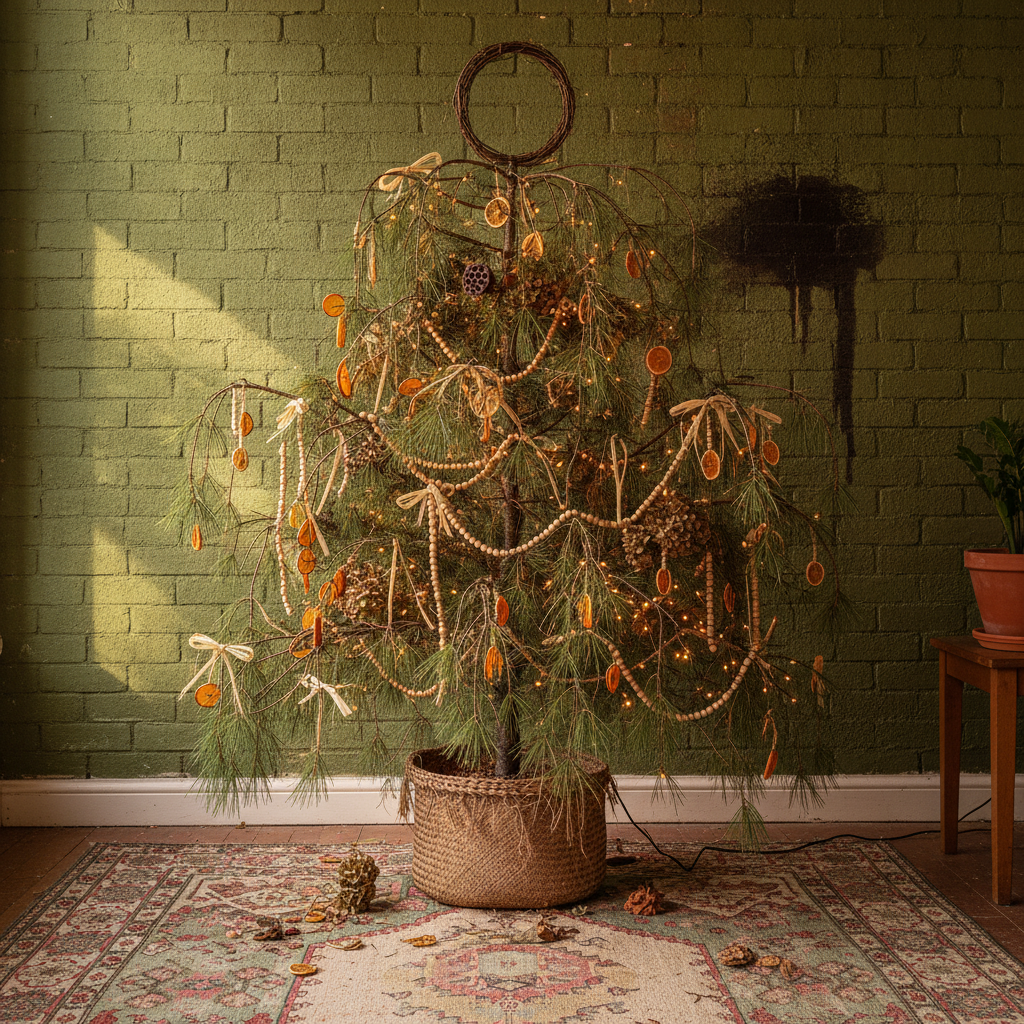
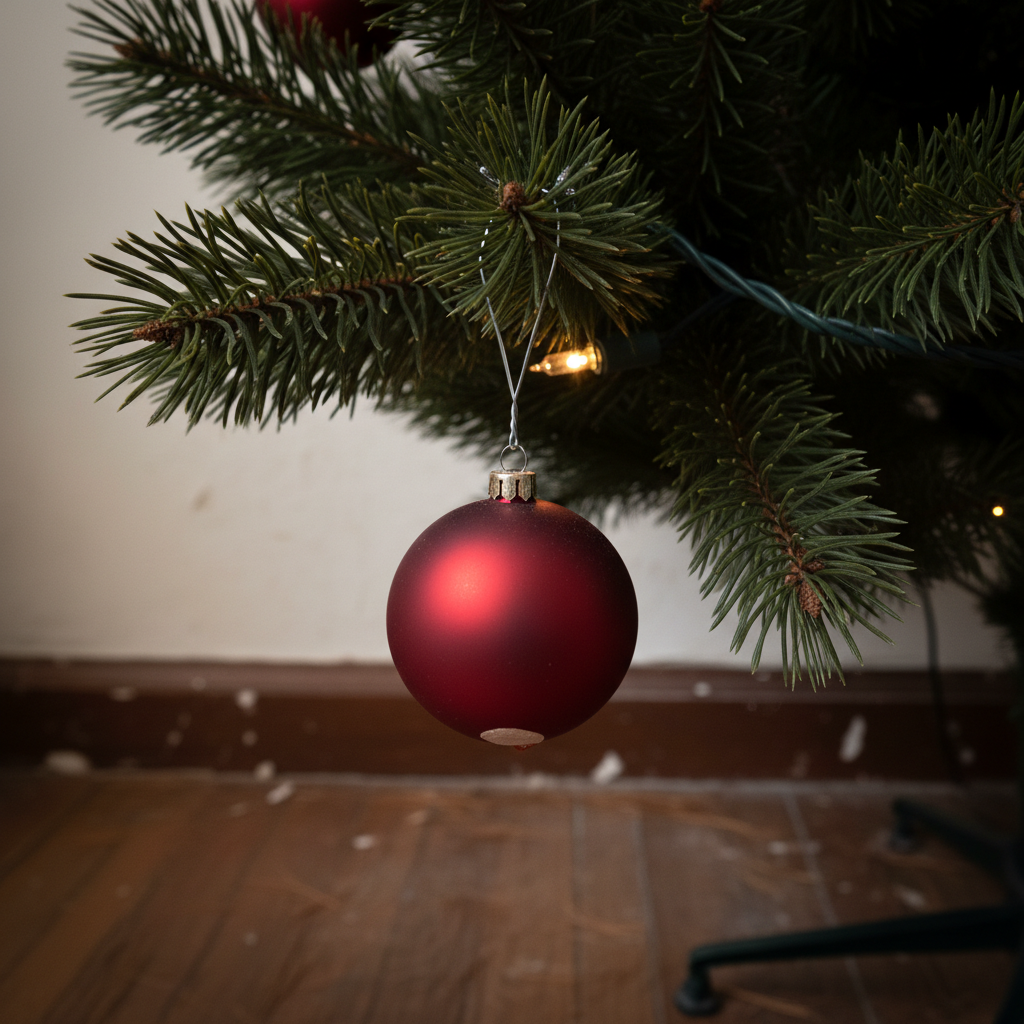
Nothing here was retouched and nothing was run twice. The captions say what the prompt asked for, what arrived and what drifted — which themes the model actually knows, where it quietly fills a restrained tree back up, and what happens when you ask a Christmas decoration to carry no writing at all.
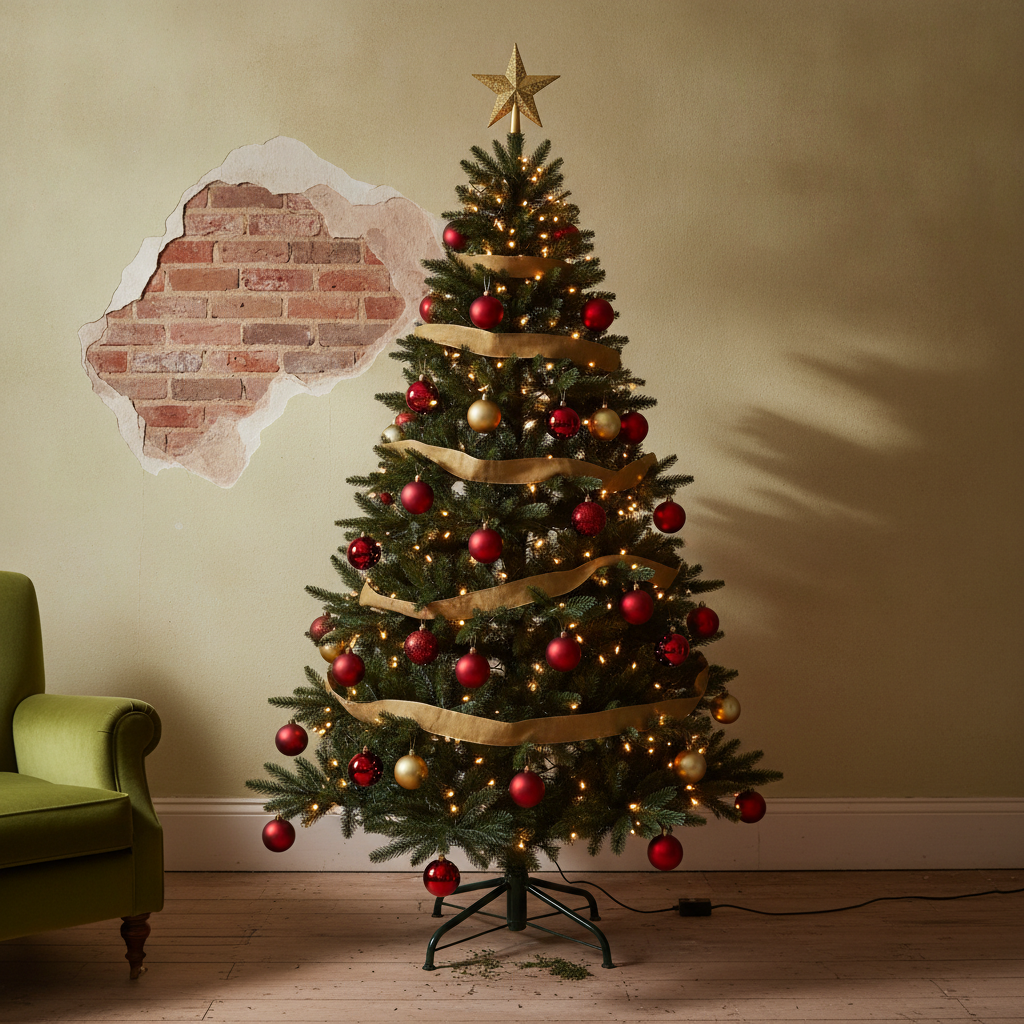
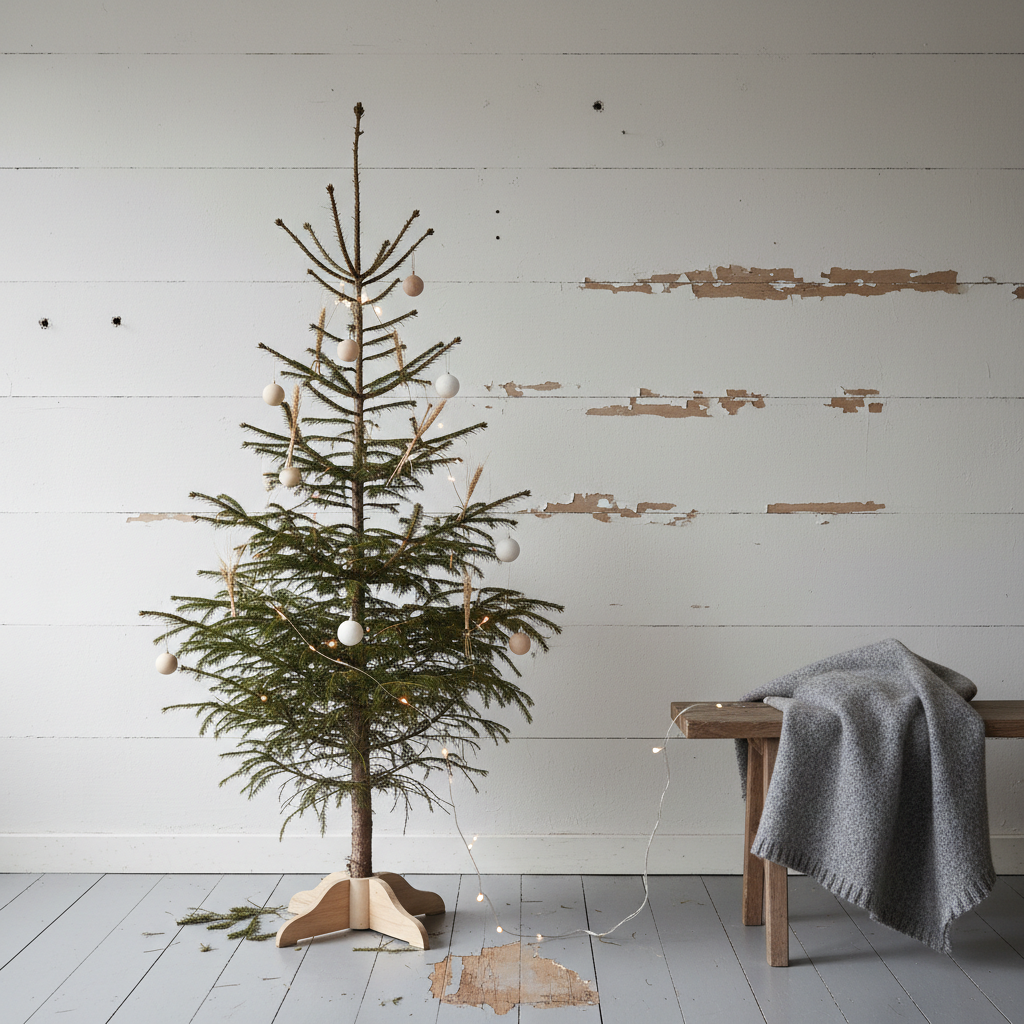
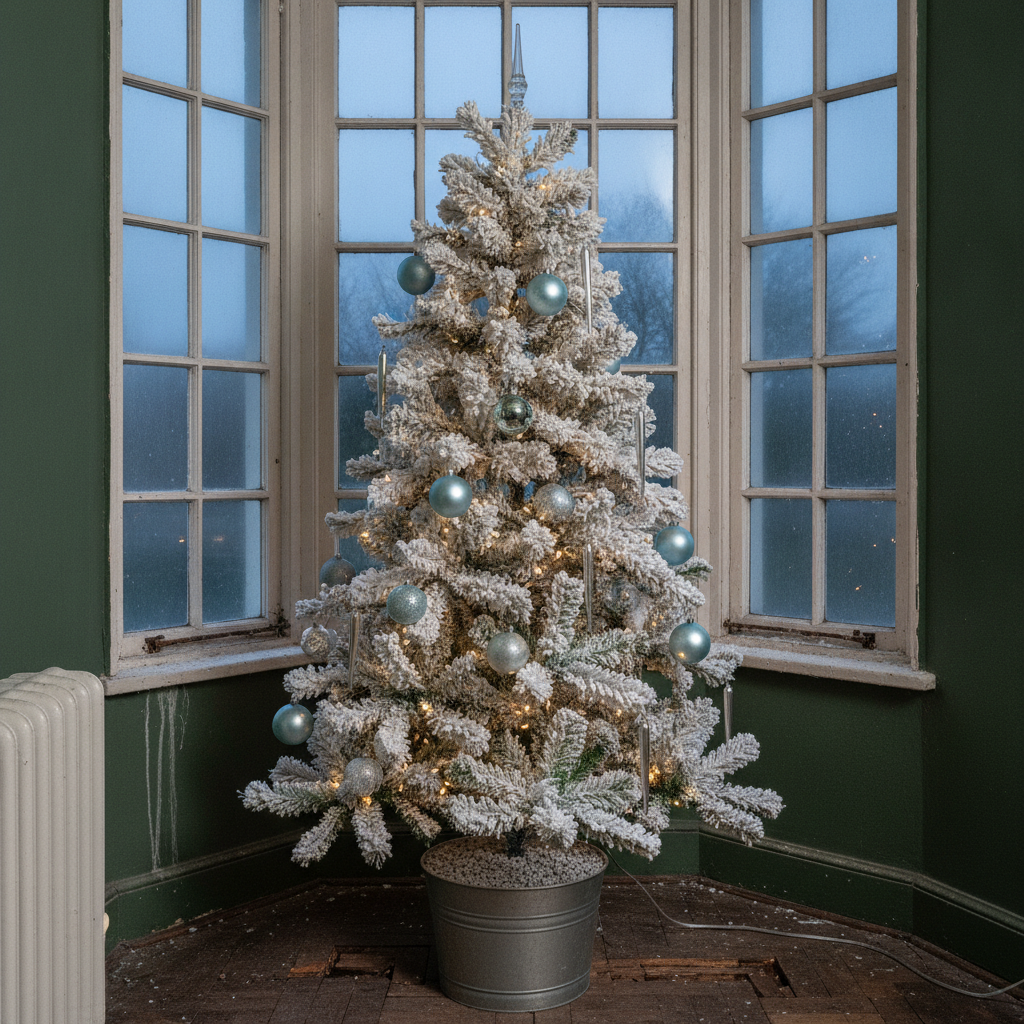
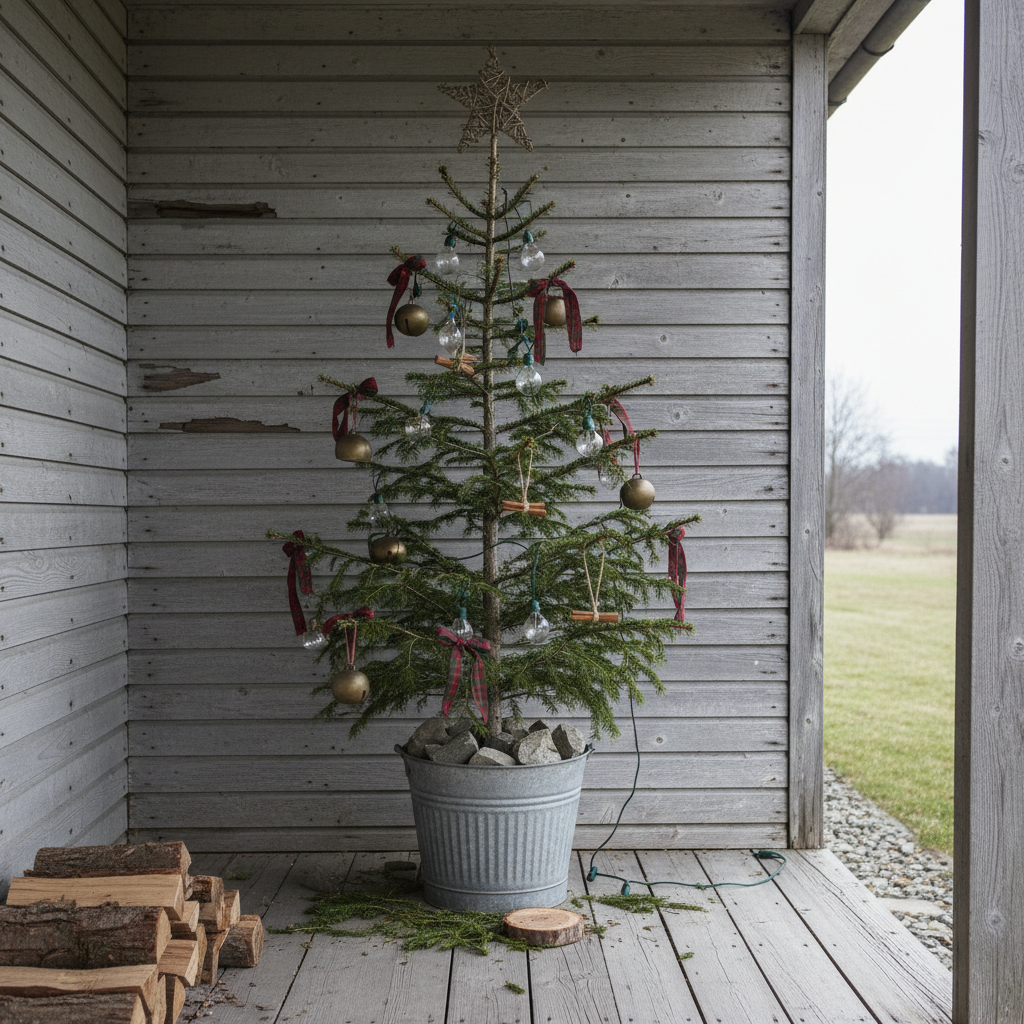
What the AI Christmas Tree Design Generator Gets Right and Wrong
A Christmas tree is a tall object covered in small repeated things, photographed in a lived-in room, and decorated in real life with objects that carry names and dates. Almost everything learned from this run comes out of those three facts.
One invented label in six frames — and not on an ornament
Every bauble, bell, ribbon and bead on this page is clean at full zoom, which is a real result on the subject most likely to spell a name or a date. The single failure was somewhere else entirely: a pair of wellington boots placed in the foreground for depth came back with a small red maker's label on each one. The itemised ban named ornaments, ribbon, garland, bucket, wall and floor — it never named the boots. The rule this adds is that the ban only protects the carriers you list, so any prop you invite into the frame needs to be either unbranded by nature or covered by the same positive clause. Swapping the boots for a stack of split logs described as plain bare timber cleared it in one rerun.
The top of the tree is the least reliable part
Two frames tested the tip in opposite directions and both are instructive. Asking for no topper at all — nothing but the leading shoot left bare — worked, which is surprising, because a star or an angel is the most expected object on a Christmas tree. Asking for a specific one did not: the frosted glass spike never appeared, and in its place a church steeple a mile away through the window lines up exactly with the trunk. Name the topper by its shape and material and say it stands upright, and check that something in the background has not taken the job.
Damage arrives as a tidy island
Two of the six rooms were asked for broken surfaces and both negotiated. The lime plaster crumbled away to brick came back as a neat patch of brickwork set into a perfectly smooth wall, with a clean soft edge all round it — damage rendered as a feature rather than as decay. The brick painted moss green and flaking back to red simply refused to flake, and the single dark stain asked for became a large black splatter. Where earlier runs on this site found that a broken wall is the strongest realism tool available, this run narrows it: ask for the damage to run off the edges of the frame and to be different in several places, or you get one tidy framed patch.
A two-colour weave collapses to one colour
Red and dark green checked cloth ribbon came back as plain burgundy on every bow but one. This is the same class of failure as a fine hexagonal weave flattening to a square grid in earlier runs: a pattern made of two colours at small scale is simplified to the dominant one as soon as the object is small in the frame. If a check, a stripe or a tartan matters, make the ribbon large in the picture or describe the pattern as a pattern — the width of the bands and which colour crosses which — rather than naming the weave.
The foreground prop stands at the subject's distance
Every preset asks for something solid close in the immediate foreground, cut by the frame edge. Cut by the frame edge lands reliably. Close to the lens does not: in three of six frames the armchair, the bench and the side table all stand at the tree's own distance and in the same sharp focus. The one prop that genuinely sat near the camera was the stack of firewood, which is a thing that lies on the floor — low objects get placed close, upright furniture gets placed back. If you want near-field depth, ask for something low.
Wear is what buys the photograph
The details that make these read as snapshots rather than catalogue images are small and specific: needles dropped under the stand, one hook twisted so an ornament hangs crooked, the light flex looping between branches and trailing out to an inline switch on the floor, flock rubbed back to green, a chip in the glaze showing pale clay. The Scandinavian frame is the proof — an almost bare pale room, which this site has repeatedly found to be the most render-prone setup there is, reads as a real photograph because the wear was placed exactly: paint flaked along board edges, two old nail holes, a chipped patch of floor paint and a cable lying across it.
How It Works
Pick the theme
Six presets: traditional red and antique gold with a wound ribbon and a star, Scandinavian minimal with bare branches and plain wood, a flocked white tree in icy blue and silver with hanging icicles, a sparse rustic fir in a galvanised bucket with checked cloth and bells, a boho pine hung with dried orange slices and wooden beads, and an extreme close-up of one branch tip. Each already carries the camera height, the wear detail and the text ban.
Add your tree, colours and room
Put the specifics in the box: the species and height, whether the tree is full or sparse or flocked, your two or three colours, whether the ornaments are matte or glossy or frosted, where the ribbon or bead garland runs, what sits at the tip, what the tree stands in, and what the wall and floor behind it look like. The room matters as much as the tree — it is what makes the picture a photograph rather than a product shot.
Check it, then download
About thirty seconds later you have the tree. Before you judge it, check three things on a zoomed crop: has any lettering crept onto an ornament or a ribbon, is the tree as restrained as you asked or has it been quietly filled back up, and is the topper actually the one you named and standing straight. Then download at up to 4K.
Writing a Prompt That Produces a Believable Christmas Tree
Four habits that separate a tree you could actually copy from one you regenerate, all learned from the six results above.
Name the materials, not the mood
Elegant, cosy and modern are the three weakest words you can give this model. Matte red glass hung deep inside the branches as well as at the tips. Plain unpainted wood balls and bundles of dried wheat tied with raffia. Thin silver icicles hanging straight down from the branch tips. Said that way the scheme arrives; said as a mood it collects into the same generic department-store tree every time.
Keep the whole tree in frame
A tall object in a room pulls the camera into either a low upward tilt or a crop that loses the topper. Stating a standing eye height in centimetres, saying the trunk should stand parallel to the sides of the frame, asking for the base of the stand and the very tip both in shot, and putting something solid in the immediate foreground cut by the frame edge are what keep the tree whole and upright.
Ban the tag, the card and the monogram
No subject on this site is closer to writing than Christmas decoration: baubles are personalised with names and dates, stockings are monogrammed, gift tags and cards exist only to be written on. A general no-text instruction is measurably weaker than refusing each carrier by name and then describing every ornament positively as plain and completely unmarked all over. Bar the word as a shape too — in the branches, in the light strings, in the gaps between ornaments.
Let the tree be slightly wrong
Real trees have a bald side against the wall, needles on the floor, one ornament hanging crooked from a twisted hook and a flex looping visibly out to the socket. Those four details do more for realism than any amount of ornament detail, because they are the things a catalogue retouches out. Put the same history in the room: plaster crumbled to brick, paint flaked off board edges, a rug worn pale along the walking line.
Who Uses an AI Christmas Tree Design Generator
Anyone changing scheme this year
Switching from multicoloured to a two-colour scheme means buying everything at once with no way to see it first. Generating your own tree in three candidate schemes before the order goes in is twenty minutes against a boot full of returns.
Small rooms and awkward corners
A tree looks different in a narrow room with a pale wall than it does in a shop. Describing the actual wall, floor and corner — and the sofa arm that will sit next to it — shows whether a 7ft flocked tree is a good idea before it is standing in the hall.
Shops, cafés and window displays
Seasonal displays are signed off weeks before the stock arrives. A generated tree in the agreed colours, photographed in a room rather than on white, is a faster way to get a decision than a mood board of someone else's photographs.
Sellers of ornaments and trees
A single bauble on white sells badly. The same bauble shown as a whole finished tree in a theme, with the room light on it, explains what a customer is buying and is quick enough to generate one per colourway.
Stylists and photographers planning shoots
A Christmas shoot is built in October from nothing. Generating the frame first — tree species, colour scheme, camera height, what sits in the foreground — settles the prop list and the lighting before a studio day is booked.
Illustrators and set designers
A tree in the background of a scene has to read as a real family tree rather than a cardboard cone. Generating it with named wear — needles down, a crooked ornament, a visible flex — gives a reference that holds up at a glance.
AI Christmas Tree Design Generator FAQ
Related Holiday Tools
AI Christmas Ornament Generator
Design the individual bauble rather than the whole tree — shape, finish and colour on its own, then describe the winner back into a tree prompt.
AI Wreath Design Generator
The door half of the same decision. Worth running in the same colours as your tree so the hallway and the front of the house actually match.
AI Christmas Card Generator
Once the tree is decided, the card is the other picture you need. Same engine, built for a card format instead of a room.
See the Tree Before You Buy the Boxes
Six themes — red and antique gold, Scandinavian minimal, flocked ice blue, rustic farmhouse, boho dried naturals and a branch close-up — each photographed with your tree, your colours and your room, in about thirty seconds. Up to 4K. Free to start, from $2.99.
Design a Christmas Tree FreeAn AI Christmas Tree Design Generator for Colour Schemes You Can Actually See
Decorating a Christmas tree is a design job with the worst possible feedback loop: you commit to a scheme in a shop in October, discover what it looks like in December with every box already open, and then live with it for a month. Nothing about the decision is reversible in the moment — the lights go on first, the ribbon is wound before the ornaments, and by the time the tree is full you can see that the copper you liked under supermarket lighting is invisible against a dark green needle. That is the gap an AI Christmas tree design generator fills. Describe the tree you already have or intend to buy and the scheme you are considering for it, and about thirty seconds later you have a photograph of that tree finished, standing in a room, in real light. Every preset on this page is written that way, and the six results above are published exactly as they came back, drifts included.
The six themes cover the decisions people actually make. Traditional deep red and antique gold with a broad ribbon wound down through the branches and a plain star at the tip. Scandinavian minimal, where the point is how much bare branch you leave showing and the ornaments are plain wood and dried wheat. Flocked white with icy blue and brushed silver and long icicles hanging straight from the tips, which is the hardest scheme to judge in advance because the flock changes every colour you hang on it. Rustic farmhouse: a sparse cut fir standing in a dented galvanised bucket with checked cloth, brass bells and cinnamon. Boho dried naturals — orange slices, wooden beads, seed pods, raffia — which has taken over the last few seasons and photographs completely differently in raking sun than under a lamp. And an extreme close-up of one branch tip, for anyone deciding between a matte ornament and a glossy one, where the whole difference lives.
A Christmas tree turns out to be a demanding subject for an image model for two specific reasons. The first is the camera: a tall object in a domestic room pulls the lens into a low upward tilt or a crop that loses the topper, so every preset states a standing eye height in centimetres, asks for the trunk to stand parallel to the sides of the frame with the base of the stand and the very tip both in shot, and puts something solid in the immediate foreground cut by the frame edge. The second is text. Real baubles carry names and dates, real stockings are monogrammed, and gift tags, cards and advent calendars exist only to be written on — so the model is primed to invent all of it. Refusing each carrier by name, describing every ornament positively as plain and completely unmarked all over, and banning presents and cards from the frame outright works far better than asking for a picture with no writing in it.
The rest is detail that any room prompt benefits from. Ornaments should be described by material and finish rather than by mood, and hung deep inside the branches as well as at the tips, because depth is what separates a decorated tree from a decorated cone. Quantity should be stated as restraint if you want restraint, since the default pull is towards a fuller tree than you asked for. Scale should be set against something human — a little taller than a person, level with the window sill. And the tree should be allowed to be slightly wrong: needles on the floor, a thin side where it has been pushed against the wall, one ornament hanging crooked, the flex looping visibly down to the socket. A worn room — plaster crumbled to brick, paint flaked from board edges, a rug worn pale along the walking line — does more for believability than any amount of ornament detail, because a perfect tree in a clean room is the most catalogue-like image this model knows how to make. Within those limits an AI Christmas tree design generator is a genuinely useful twenty minutes to spend before the first box is opened.