
AI Garden Path Design Generator
A path is the one thing in a garden you cannot move once it is down, and the one thing nobody can picture from a sample board. A single wet flagstone on the forecourt of a builders' merchant tells you nothing about how eighty of them will look running between your borders. This AI garden path design generator turns a description into a path photographed in a real garden in about thirty seconds — riven sandstone with planted joints, golden gravel between oak sleepers, granite stepping stones in lawn, old clay brick in a walled garden, chipped bark through woodland and porcelain planks at dusk.
Design a Garden Path FreeTry the AI Garden Path Design Generator — Free
Pick a surface, then use the box for what is specific to your garden — the width in centimetres, where the path starts and what it ends at, how it is edged, and what grows along it. Each preset already carries the camera height, the worn-in detail that keeps a new path from looking like a showroom, and the itemised ban on engraved slabs, plant labels and maker marks that produced the six pictures below.
AI Garden Path Design Generator
Choose a surface, name your width, your edging and what the path runs between, and get a photorealistic garden path in a real garden. Up to 4K.
Six Paths From the AI Garden Path Design Generator, Shown Exactly As They Came Back
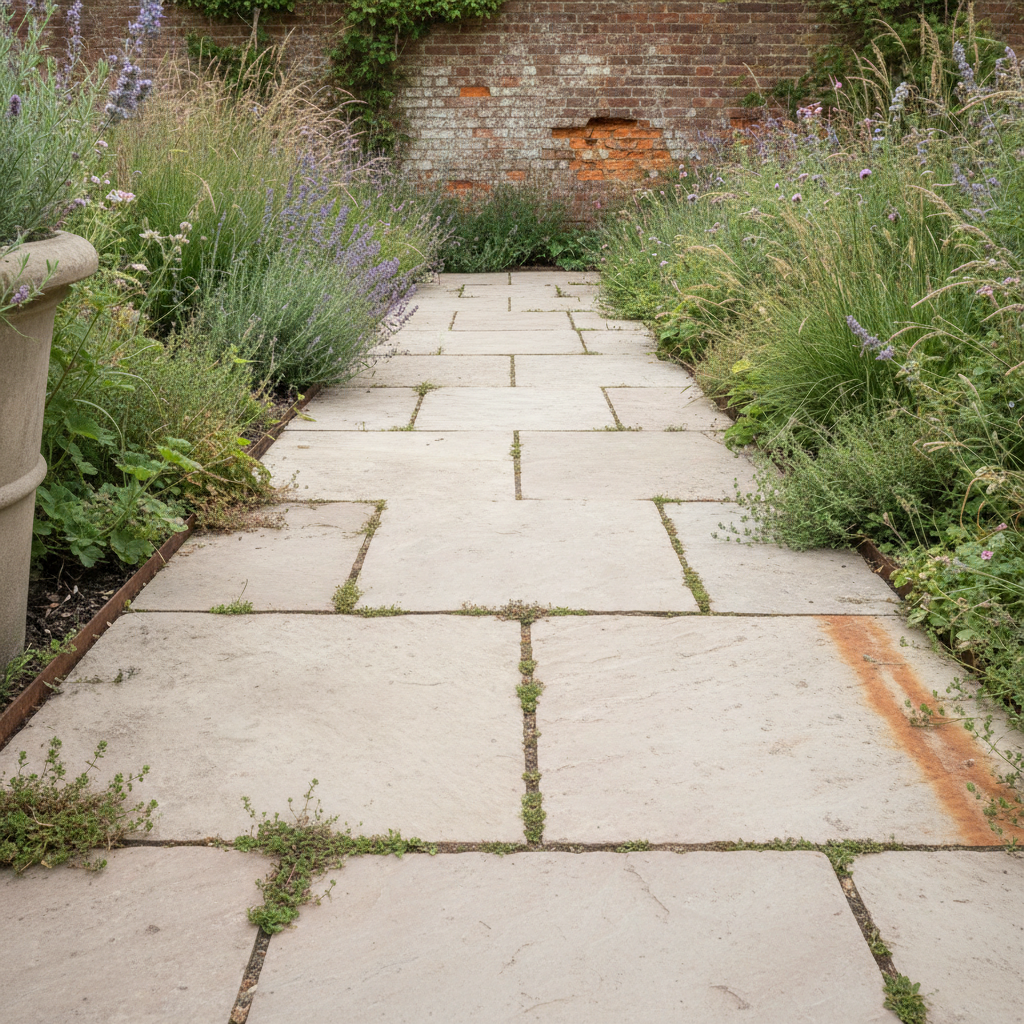
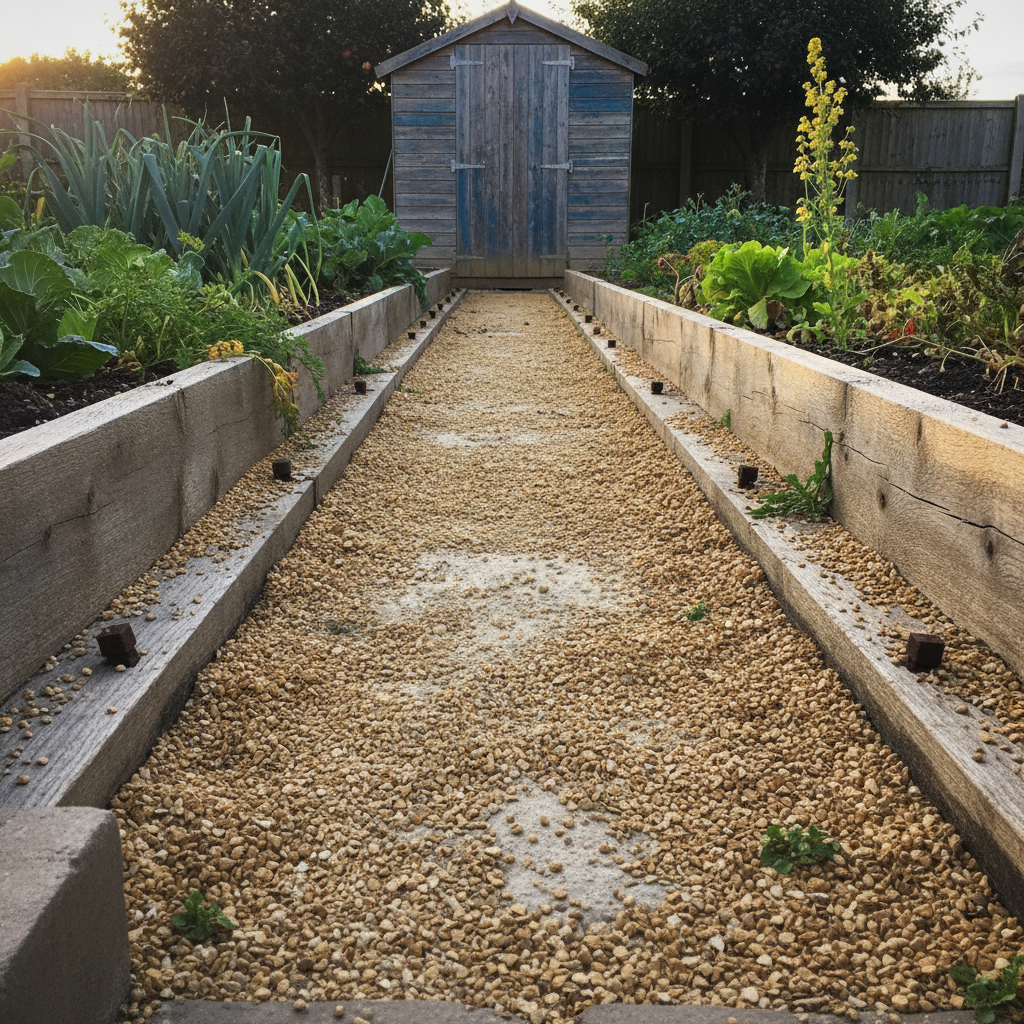
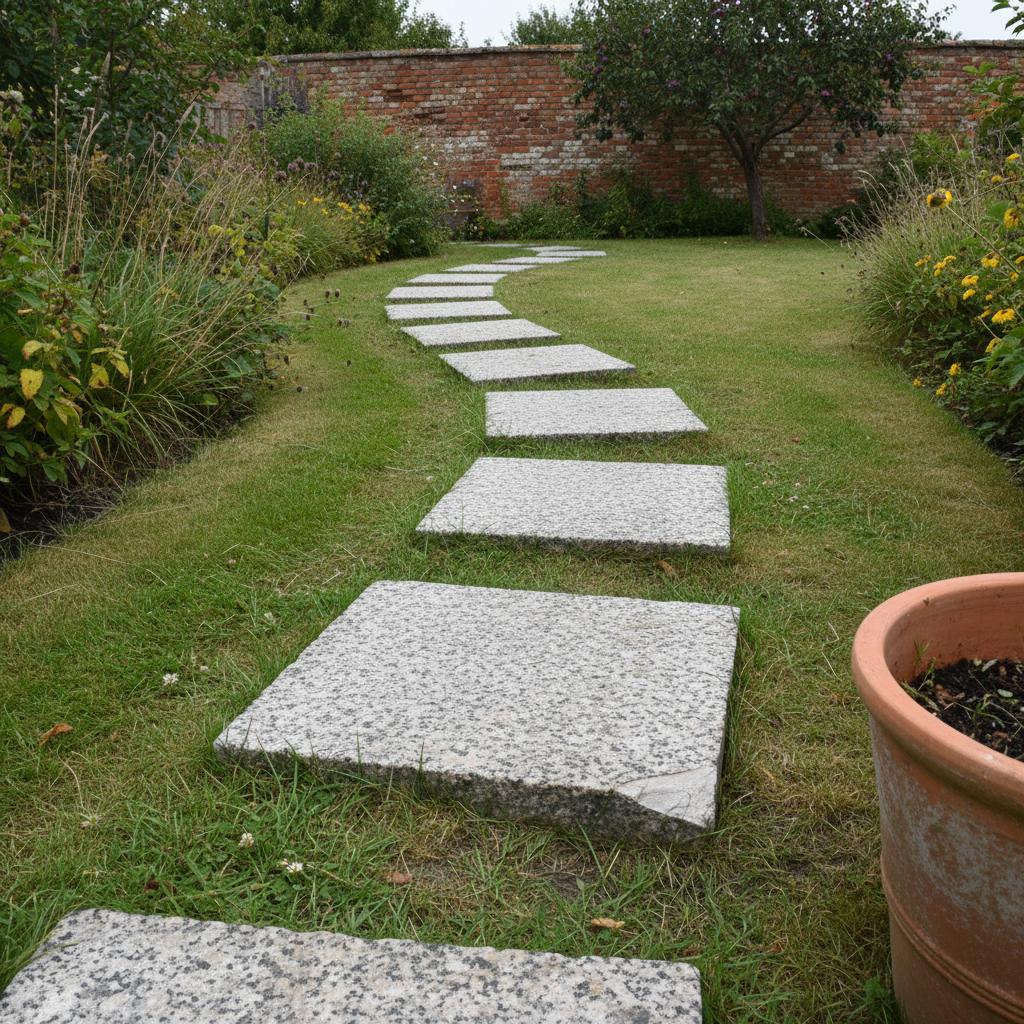
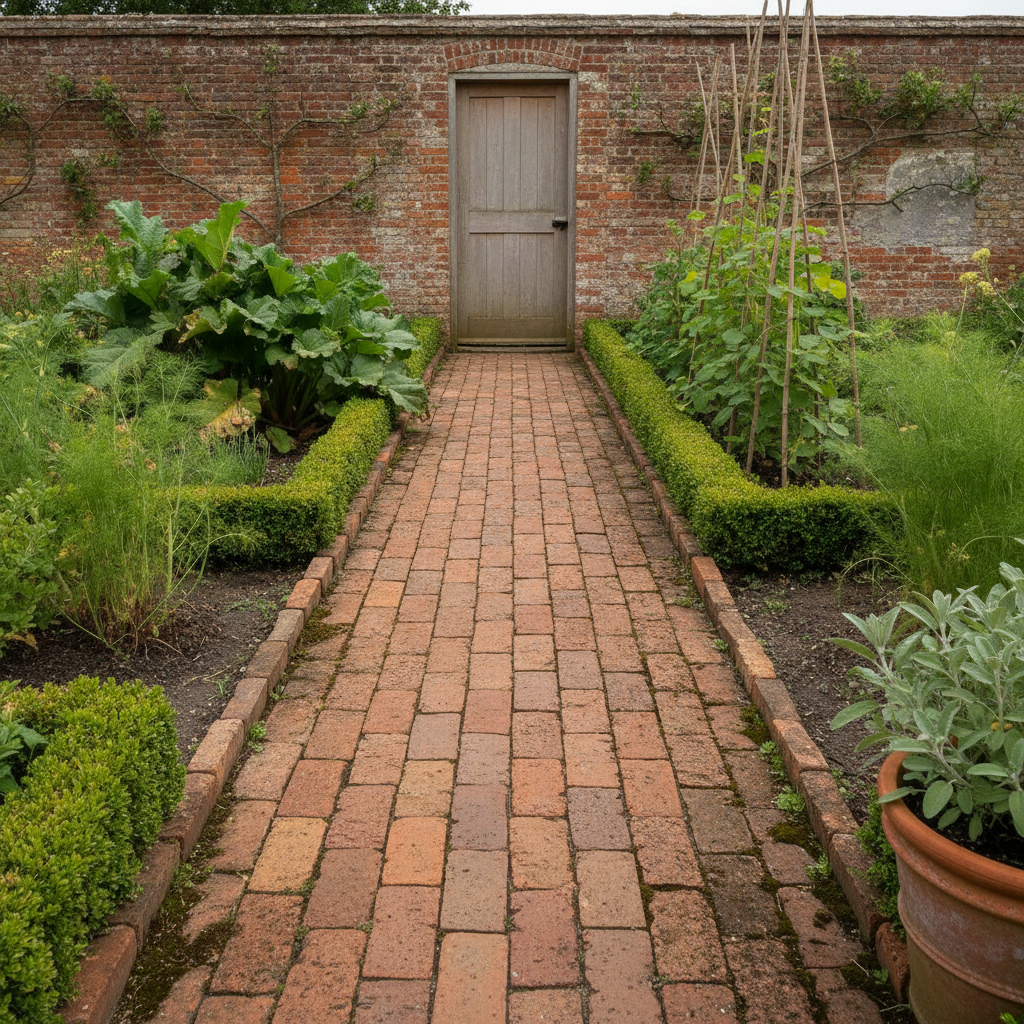
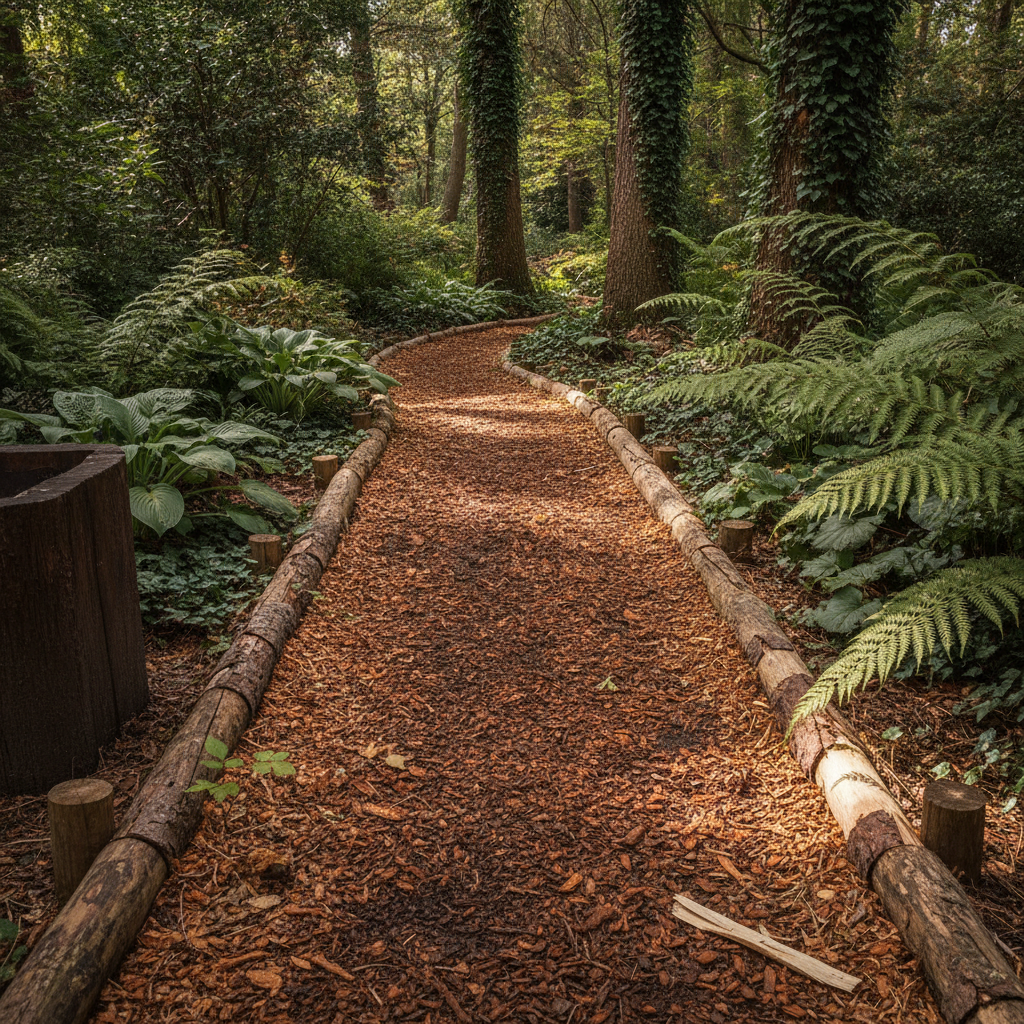
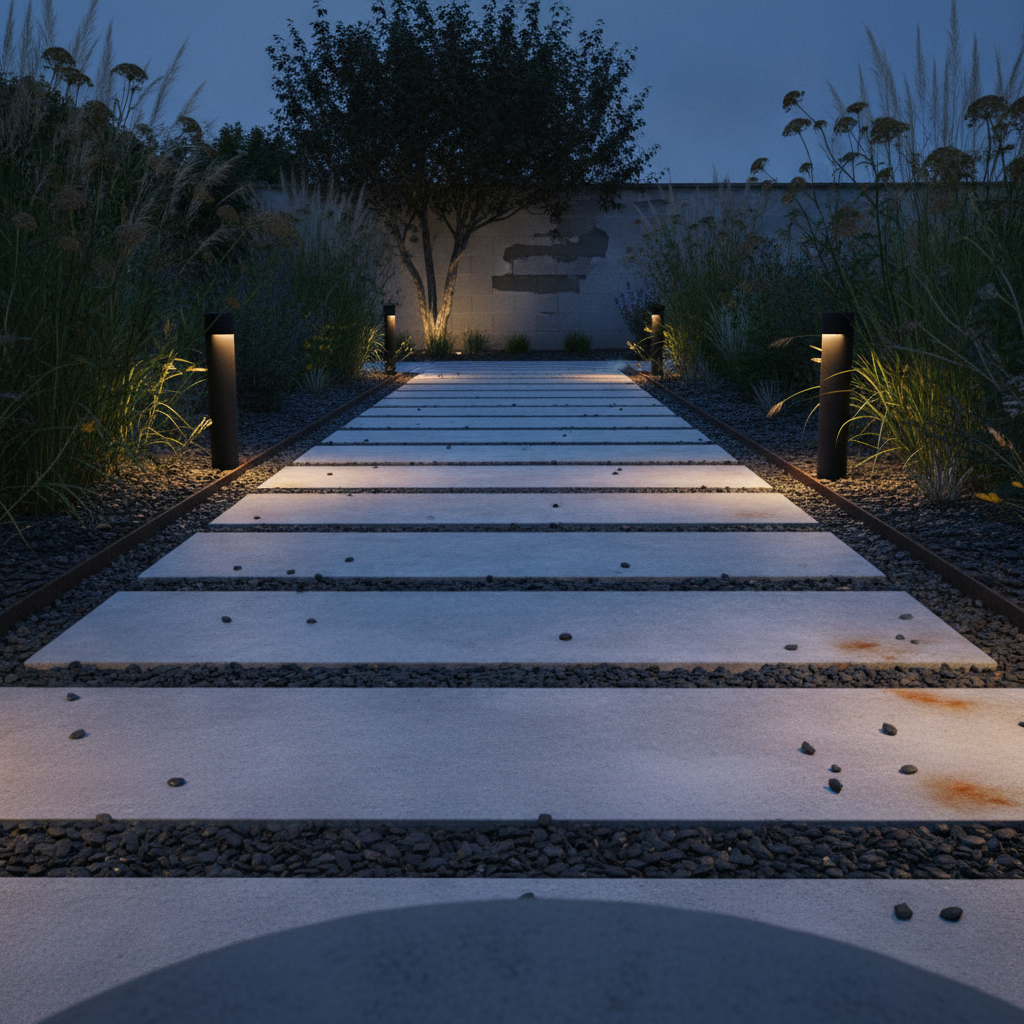
Nothing here was retouched and nothing was run twice. The captions say what the prompt asked for, what arrived and what drifted — the rust that bled from the edging exactly as described, the stepping stones that refused to bed into the lawn, the curve that straightened out and the spikes that never went through anything.
What the AI Garden Path Design Generator Gets Right and Wrong
A path is a horizontal surface, a repeated unit and a route from one thing to another. Almost everything learned from this run comes out of those three facts.
A path is the worst camera problem on this site, and a foreground object fixes it
A garden path is a horizontal plane covered in a repeating pattern, which is the exact pair of properties that has tipped the lens into a plan view on every previous page here. Not one of these six frames is an overhead shot. What did it was the clause carried in every preset: a stated camera height in centimetres, the far end of the path described as sitting level with the lens, and something solid close in the immediate foreground that is cut by the bottom edge of the frame, because that crop is physically impossible from above.
Leave the foreground object unnamed and the model invents a container
The foreground clause deliberately did not say what the object was. Four of the six frames filled the gap with a container — a stone urn, a terracotta pot in two of them and a timber trough — and the other two used a concrete block and the near edge of the paving itself. The clause works either way, but if the thing in the corner of your picture matters, name it. Left open, this model reaches for a pot.
Bedding into gravel works, bedding into turf does not
The stepping stones were given the full bedding formula that buried rocks in gravel convincingly on an earlier page: the top sitting below the surrounding level, the surface growing hard against all four edges, and no gap, no shadow slot and no visible flat base. Every slab came back sitting squarely on top of the lawn with its whole thickness showing. Gravel can be banked up against a shape; mown turf is drawn as one continuous plane with objects placed on it, and words do not cut into it.
A curve lands on loose and discrete surfaces and fails on a jointed slab field
Three presets asked the path to bend. The stepping stones curved left as described, the bark path wound out of sight round a bend, and the sandstone path — the only one made of large slabs butted into a continuous jointed surface — ran dead straight to the wall. A route made of separate units or of loose material can be bent one piece at a time. A continuous field of rectangular slabs appears to resist it, so plan a straight run if your surface is large-format paving.
A fixing whose run disappears into the ground is placed by plausibility
The single most reliable fixing found anywhere in this series is a peg driven right through a body with both sawn ends standing proud. Here it failed, and the reason is precise: the spike was specified to pass through the sleeper and into the ground, so most of its run is invisible. What came back is a scatter of small dark blocks sitting on top of the timber. The through-peg only holds when the whole of it can be seen. If one end buries itself, expect a lump placed wherever one looks reasonable.
Wear transfers between a named pair of objects, and only then
The clearest piece of realism in this run appears twice: a rust-orange stain bleeding from a weathered steel edging strip out onto the pale stone immediately beside it, on the sandstone path and again on the porcelain. Both are written as a transfer between two named objects. The same prompts asked more loosely for a soft film of weathering and for damp patches in the lee of the planting, and those are barely there. Pin the wear to an object pair, not to a surface.
How It Works
Pick the surface
Six presets: riven buff sandstone with creeping thyme in open joints, golden self-binding gravel held between silvered oak sleepers, square sawn granite stepping stones bedded into lawn, old handmade clay brick worn hollow down the middle, coarse chipped bark edged with half-round logs, and pale porcelain planks separated by strips of dark basalt chippings. Each one already carries the camera height, the wear and the text ban.
Add your width, your edge and your route
Put the specifics in the box: how wide the path is in centimetres, whether it runs straight or curves out of sight, what holds the edges — steel strip, brick on edge, oak sleeper, half-round log, nothing at all — and above all what it runs between and what it ends at. A path is a route, and a path with nowhere to go is the single easiest way to get a picture that looks computer generated.
Check it, then download
About thirty seconds later you have a path. Before you judge it, check three things on a zoomed crop: has the camera stayed on the ground or crept up into a plan view, do the units actually run in the pattern you asked for all the way down the path, and is there anything written or stamped on a slab, a kerb or a light. Then download at up to 4K.
Writing a Prompt That Produces a Believable Garden Path
Four habits that separate a path worth showing a landscaper from one you regenerate, all learned from the six results above.
Keep the camera on the ground
A path is a horizontal surface covered in a pattern, which is the exact combination that pulls this model up into a plan view. Two things hold the lens down: a stated height in centimetres with the far end of the path described as sitting level with the lens, and something solid in the immediate foreground — a kerb, a pot, the corner of a hedge — that is cut by the bottom edge of the frame, because that crop is only possible from a low camera.
Give the path somewhere to go
Every preset here ends at something: a shed door, a door in a wall, a bend behind a tree, a border the path disappears behind. A destination gives the picture its perspective and its sense of scale, and it stops the surface being presented as a sample. Name what the path leaves from and what it arrives at, and say whether it is lost round a bend or visible all the way.
Describe the laying, never the trade name
Herringbone, basketweave, stretcher bond and random rectangular all mean something to a bricklayer and almost nothing to this model, which has repeatedly returned a different pattern from the one it was given a name for. Describe the geometry instead: which way the long side of the unit runs, whether each course sits directly behind the one before it, and what finishes the edge.
Put the wear where it belongs
A new path looks rendered. An old one looks photographed. The wear that works is pinned to a named place and, better still, to a pair of objects: the middle of the slabs worn pale and dished where people walk, moss in the joints along the shaded edge only, rust bled from a steel edging strip onto the pale stone right beside it. Asking generally for a weathered finish does nothing.
Who Uses an AI Garden Path Design Generator
Anyone about to order two tonnes of paving
Stone is sold by the sample and laid by the pallet, and the gap between those two things is where most regret lives. Generating the same route in sandstone, in brick and in gravel takes ten minutes and settles an argument that would otherwise be settled by whichever sample happened to be dry on the day.
Landscape designers presenting a layout
A path on a plan is a pair of lines, which is the one drawing a client genuinely cannot read. A photograph of the proposed surface running between the planting, at eye level, with a real shadow across it, carries a scheme far better than a hatch pattern and takes thirty seconds rather than an evening.
Landscapers and paving contractors quoting work
Showing a customer the difference between butt-jointed riven stone with planted joints and a mortared joint before anything is ordered saves the conversation that otherwise happens after the first course is down. Just do not read the picture as a setting-out drawing, because unit counts and laying patterns are the least reliable things in it.
Allotment and kitchen gardeners
The path between the beds is the most-used and least-planned surface on any plot. Seeing golden gravel between oak sleepers, old brick between box hedges and bark between logs on your own ground makes the decision in an afternoon instead of over a season of mud.
Self-builders and renovators
The route from the gate to the door sets the tone for the whole front of a house and is usually decided last, in a hurry, from whatever the merchant has in stock. Generating it against the right brick and the right wall is a far better basis for the order than a product page.
Anyone with a lawn worn through to mud
A desire line across the grass is the cheapest path problem to fix and the easiest to get wrong. Trying stepping stones bedded into the turf, a narrow bark run and a full gravel path on the same line shows very quickly which one your garden can actually carry.
AI Garden Path Design Generator FAQ
Related Design Tools
AI Patio Design Generator
The same paving decision laid out as a space rather than a route. Worth generating alongside a path, because the two usually share a material and the patio is where the camera problem is hardest to beat.
AI Driveway Design Generator
The front-of-house version of the same question, in heavier materials and with a kerb and a threshold to resolve. The page where the limits of asking for a named laying pattern first became obvious.
AI Front Yard Design Generator
Where most garden paths actually begin. Generate the whole frontage first if the path has to get from a gate to a door, because the planting and the boundary decide what the path can be.
See the Path Before You Order a Single Pallet
Six surfaces — riven sandstone with planted joints, golden gravel between oak sleepers, granite stepping stones in lawn, old clay brick in a walled garden, chipped bark through woodland and porcelain planks at dusk — each photographed at your width, on your route, in your light, in about thirty seconds. Up to 4K. Free to start, from $2.99.
Design a Garden Path FreeAn AI Garden Path Design Generator for Surfaces, Edges and Routes You Can Actually See
A garden path is the most permanent thing most people ever build outdoors and the hardest thing to judge in advance. It is bought as a single damp sample on a merchant's forecourt, decided from a catalogue photograph shot in Mediterranean light on a bed of brand new jointing compound, and then laid for twelve metres through planting that looks nothing like the catalogue. Nobody can picture that jump, which is why so many paths end up the wrong width, the wrong colour against the house, or the wrong material for the amount of shade they sit in. That is the gap an AI garden path design generator fills. Describe the surface, the width in centimetres, the edging, what the path runs between and what it ends at, and about thirty seconds later you have a photograph of it there. Every preset on this page is written that way, and the six results above are published exactly as they came back, drifts included.
The six builds cover the surfaces most people are genuinely choosing between. Riven buff sandstone flagstones butted together with wide open joints grown through with creeping thyme, london pride and moss. Golden self-binding gravel rolled firm between two silvered oak sleepers spiked down through the timber. Square sawn granite stepping stones bedded into a mown lawn so the grass grows hard against every edge. Old handmade clay brick laid in courses across the width of a walled kitchen garden path and worn hollow down its centre. Coarse chipped pine bark edged with half-round logs winding through hostas and ferns. And long pale porcelain planks separated by strips of dark basalt chippings, lit by low bollards at dusk. Between them they cover hard and soft, formal and informal, and the full range from a path you lay in an afternoon to one you pay a contractor for.
A path turns out to be an unusually demanding subject for an image model, for one specific reason: it is a horizontal plane covered in a repeating pattern, and that combination is the strongest pull this model has towards an overhead view. Every other finding on this page follows from fighting that. A stated camera height in centimetres helps. Describing the far end of the path as sitting level with the lens helps more. The reliable fix is a solid object in the immediate foreground that is cut by the bottom edge of the frame, because that crop is physically impossible from above. The second demand is scale: a path has no inherent size, so it borrows one from whatever it runs between and whatever it ends at, which is why every preset here names a destination.
The rest is detail that any prompt for any paving will benefit from. Trade names for laying patterns are weak and should be replaced with geometry — which way the long side of each unit runs, whether each course sits directly behind the one before it, what finishes the edge. Wear should be pinned to a named place and ideally to a pair of objects, because a general request for a weathered finish is ignored while rust bleeding from a steel edging strip onto the pale stone beside it lands almost every time. And the text ban has to name its carriers one at a time: the slab, the kerb, the sleeper, the bollard light, the screw head, the plant label, and the carved recess that writing would sit in. Within those limits an AI garden path design generator is a genuinely good way to spend twenty minutes before committing to a surface you will be walking on for twenty years.