
AI Macrame Pattern Generator
Macrame is decided in reverse: you buy the cord, cut it four times longer than the finished piece, and only find out what the proportions look like once the work is too far along to undo. This AI macrame pattern generator turns a description into a finished piece photographed on a real wall in about thirty seconds — a fringed wall hanging on a driftwood dowel, a spiral plant hanger, a doorway curtain, a hanging chair, a table runner and a close-up of the knots themselves.
Design a Macrame Piece FreeTry the AI Macrame Pattern Generator — Free
Pick a project, then use the box for what is specific to yours — the finished width and drop, the cord colour and thickness, which knots you want where, how deep the fringe is, what it hangs from and what wall it hangs on. Each preset already carries the camera height, the handmade tension that stops cord looking rendered, and the itemised ban on charts, signs and words knotted into the cords that produced the six pictures below.
AI Macrame Pattern Generator
Choose a project, name your cord, your knots and your fringe, and get a photorealistic macrame piece hung in a real room. Up to 4K.
Six Pieces From the AI Macrame Pattern Generator, Shown Exactly As They Came Back
Nothing here was retouched and nothing was run twice. The captions say what the prompt asked for, what arrived and what drifted — which knots the model actually knows, where it tidies up the handmade tension it was told to keep, and what happens when a piece is asked to hang in front of an open doorway.
What the AI Macrame Pattern Generator Gets Right and Wrong
Macrame is a repeating structure made of soft material, hung flat against a wall, and real examples of it very often spell a word. Almost everything learned from this run comes out of those three facts.
Macrame is primed to spell words, and nothing spelled anything
All six frames are free of invented lettering, checked at full zoom on the knots, the fringe and the gaps between the cords. That matters more here than on most subjects, because real macrame genuinely does spell things — a name over a cot, a word above a bed — so the model has every reason to push letterforms into the structure itself. The presets refuse the word as a shape rather than as text, and remove the objects a craft room would carry writing on: charts, instruction sheets, signs, books and tape measures.
A graded lattice comes back as a regular one
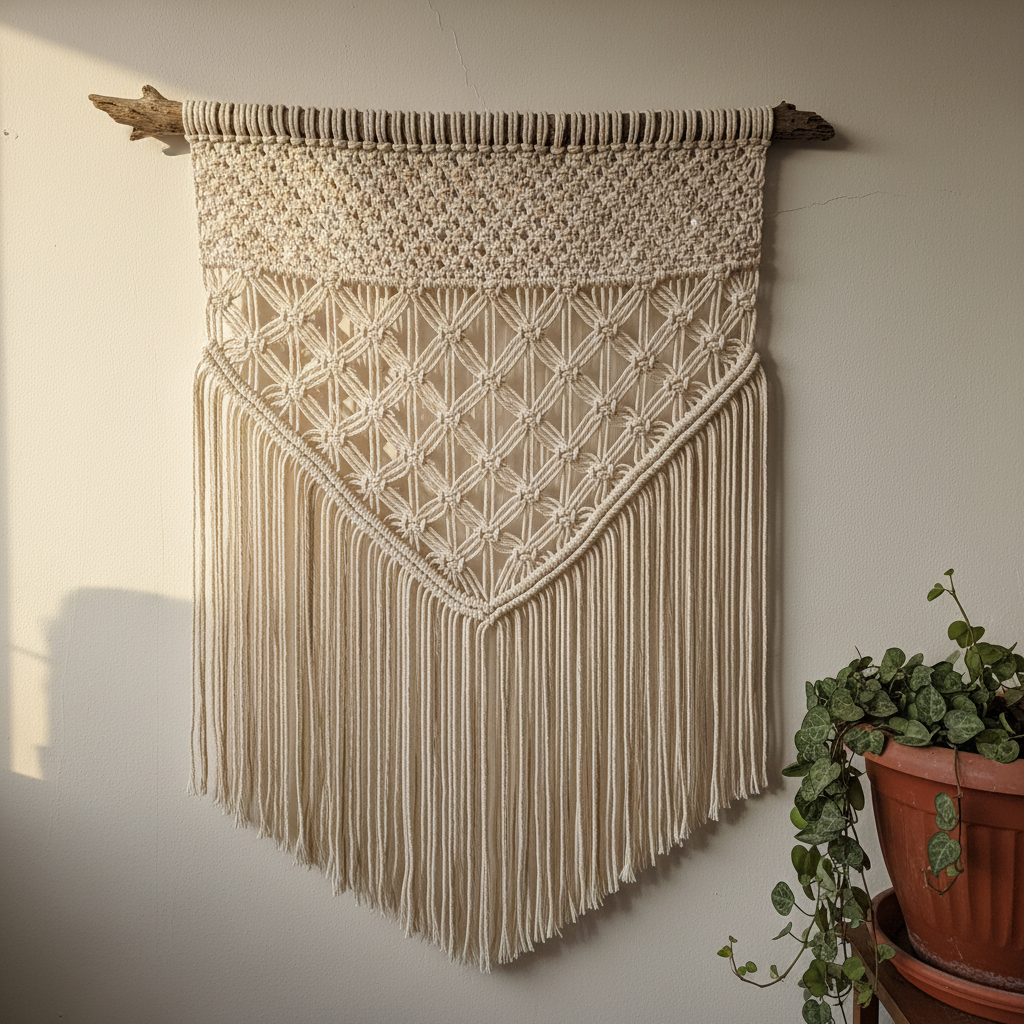
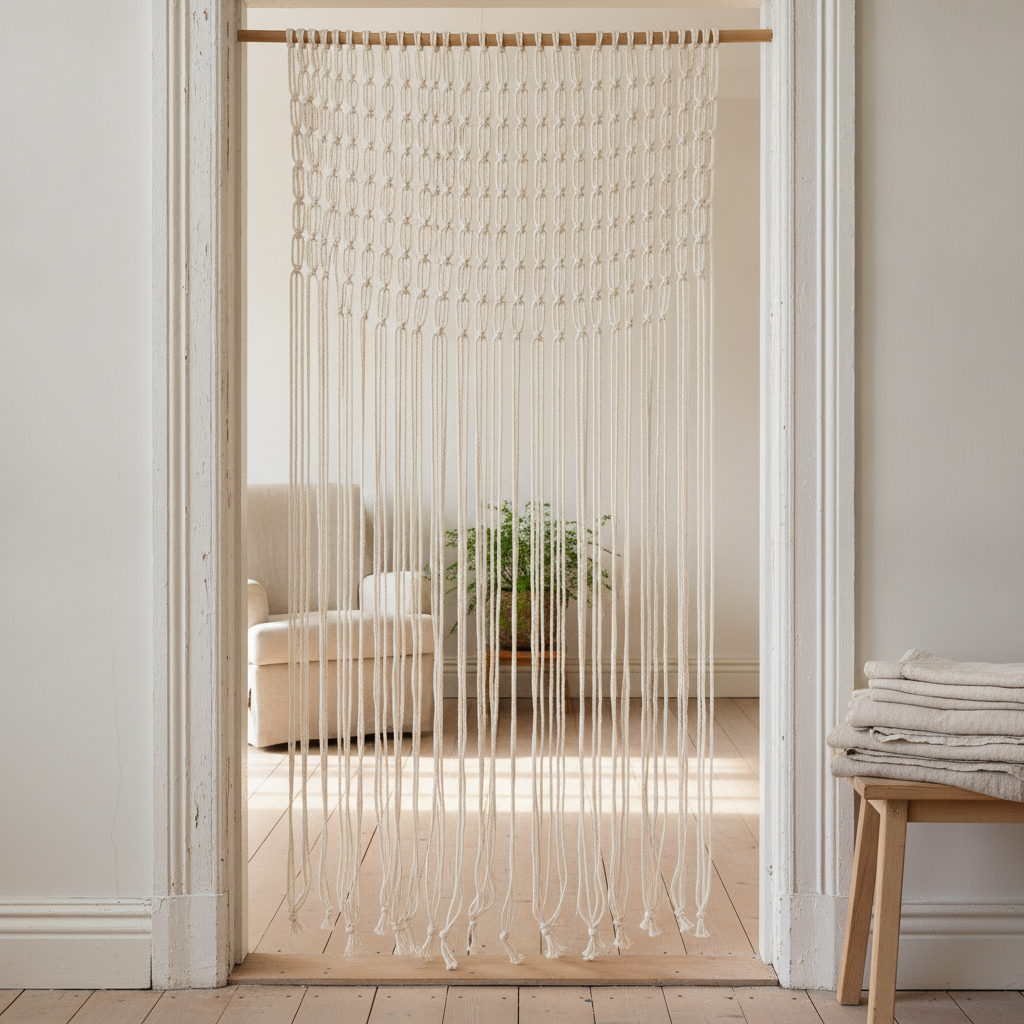
The wall hanging asked for diamonds largest in the middle of the panel and shrinking towards the sides. What arrived is a flawless uniform net of identical diamonds. The doorway curtain asked for a few cords twisted around one another where they had been brushed past, and came back with every cord parallel and evenly spaced. Repeated identical units settle into a regular lattice whatever you say about varying them, which is the single most reliable failure in this whole series.
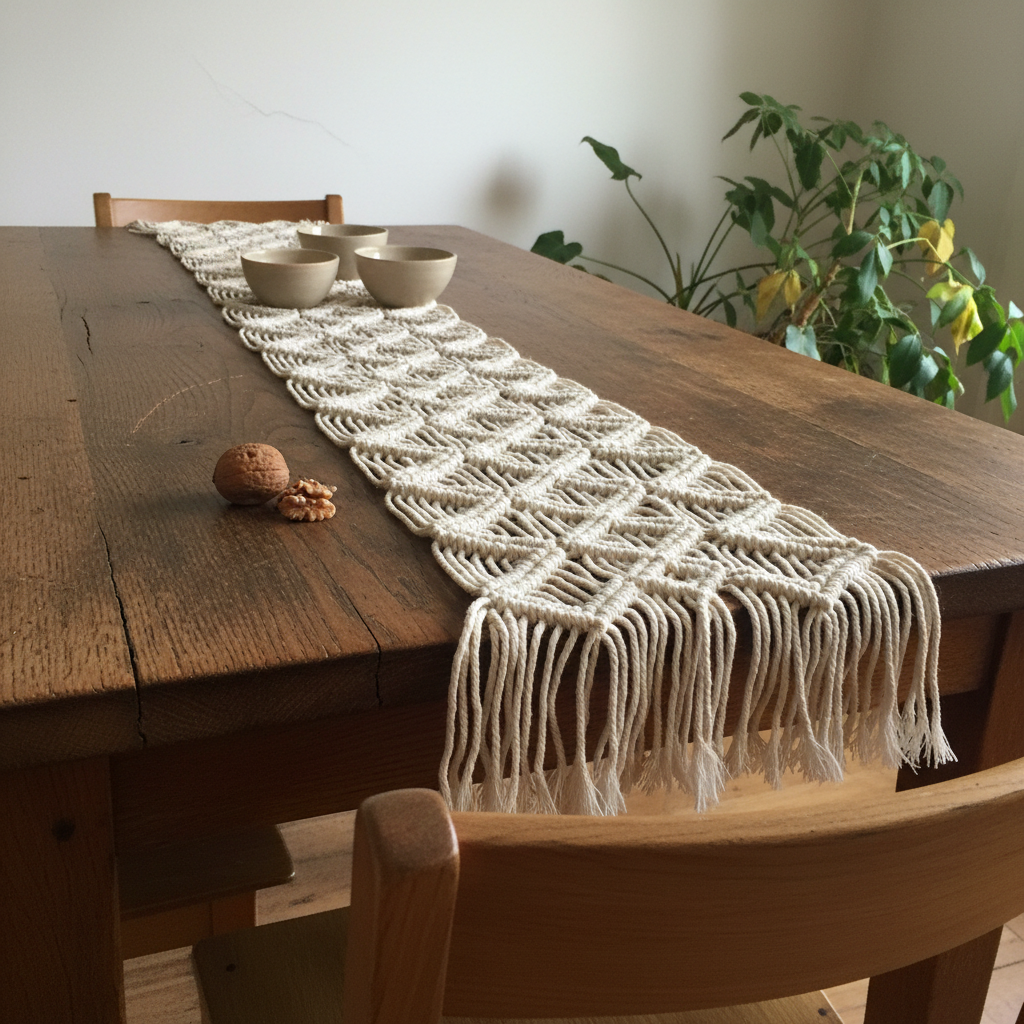
Knotwork on a table did not force a flat-lay
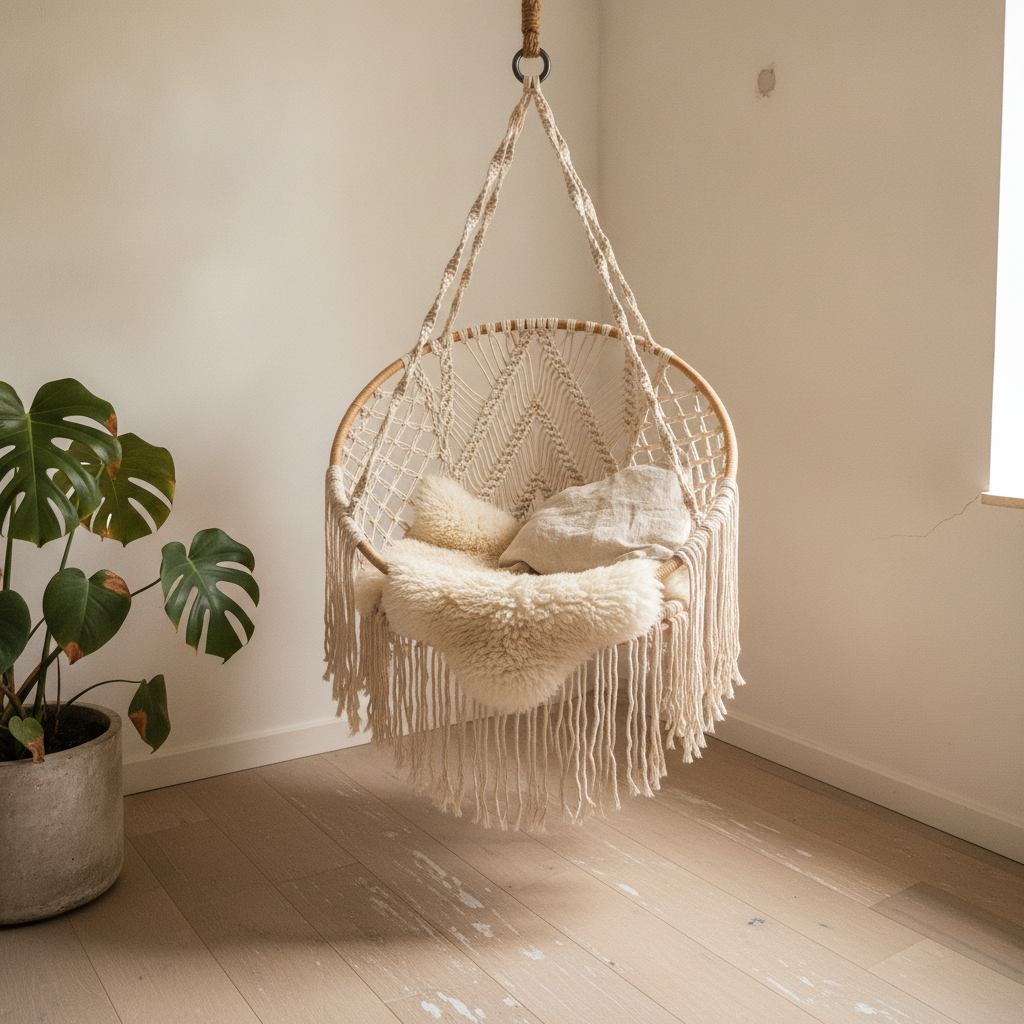
A tabletop covered in a fine repeating pattern is exactly the combination that has tipped the lens into an overhead view on earlier pages. Shooting it from a stated seated height, describing the table as a band narrowing sharply with distance rather than a pattern laid out below the lens, and putting a chair back in the immediate foreground cut by the frame edge held the camera down. The one frame that climbed is the hanging chair, where the floor had to be visible for the chair to read as hanging.
Named flaws in named places are what stop cord looking like plastic
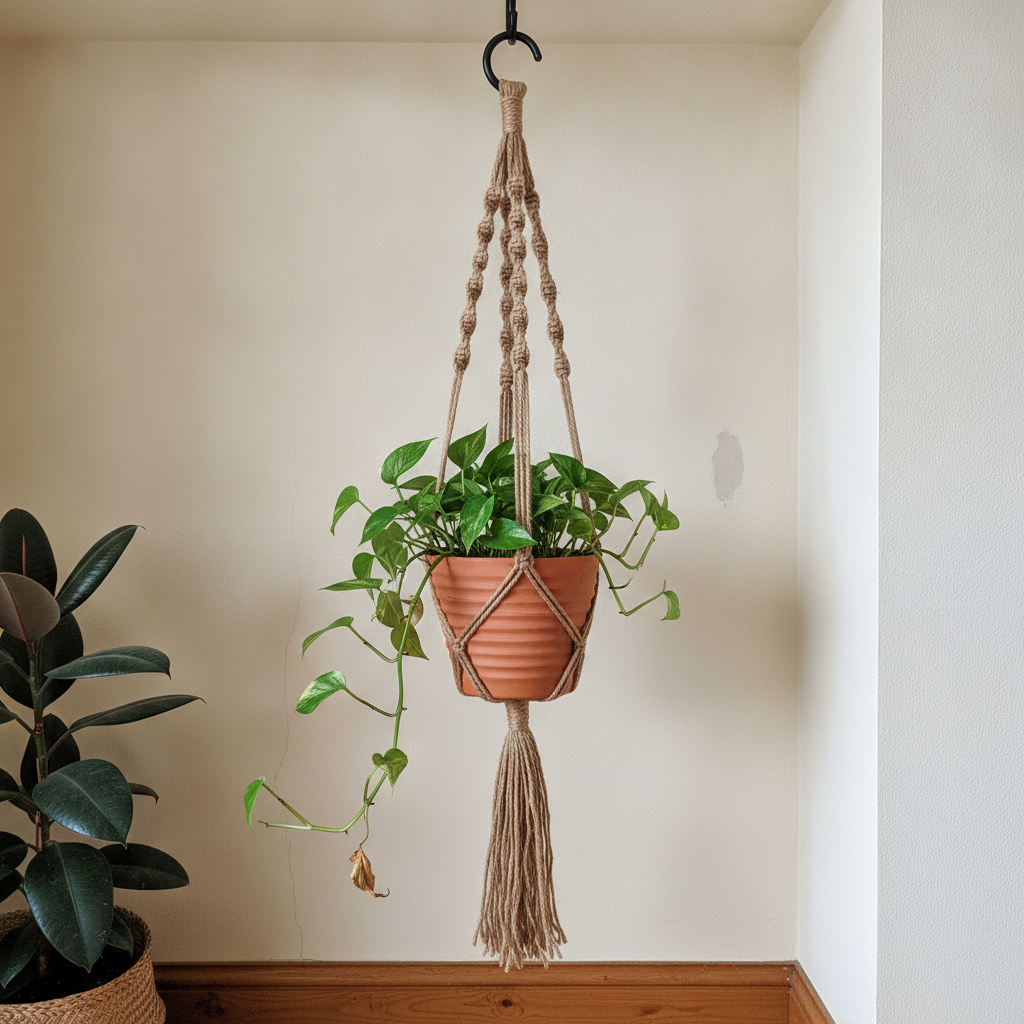
The details that make these read as photographs are all specific: one pothos leaf browning at the tip, a hairline crack running up from the skirting, a repair patch feathered into the plaster with no straight edge, chalky paint surviving only down in the grain of the architrave, stray fibres standing out of the three-ply cord. The looser asks in the same prompts — handmade tension, an unevenly combed fringe — were quietly tidied up in almost every frame.
A named fitting substitutes to its nearest neighbour
The hanging chair was specified as a thick rope passing over a dark steel ceiling bracket. A dark steel ring arrived instead. The same prompt asked for one crumpled linen cushion and got two. Naming an object narrows what it can turn into, but it does not pin it: expect the near neighbour, and expect small counts of soft furnishings to drift upwards while counts of hard objects — three bowls, two walnuts — hold exactly.
Name the shape a knot makes, not just the knot
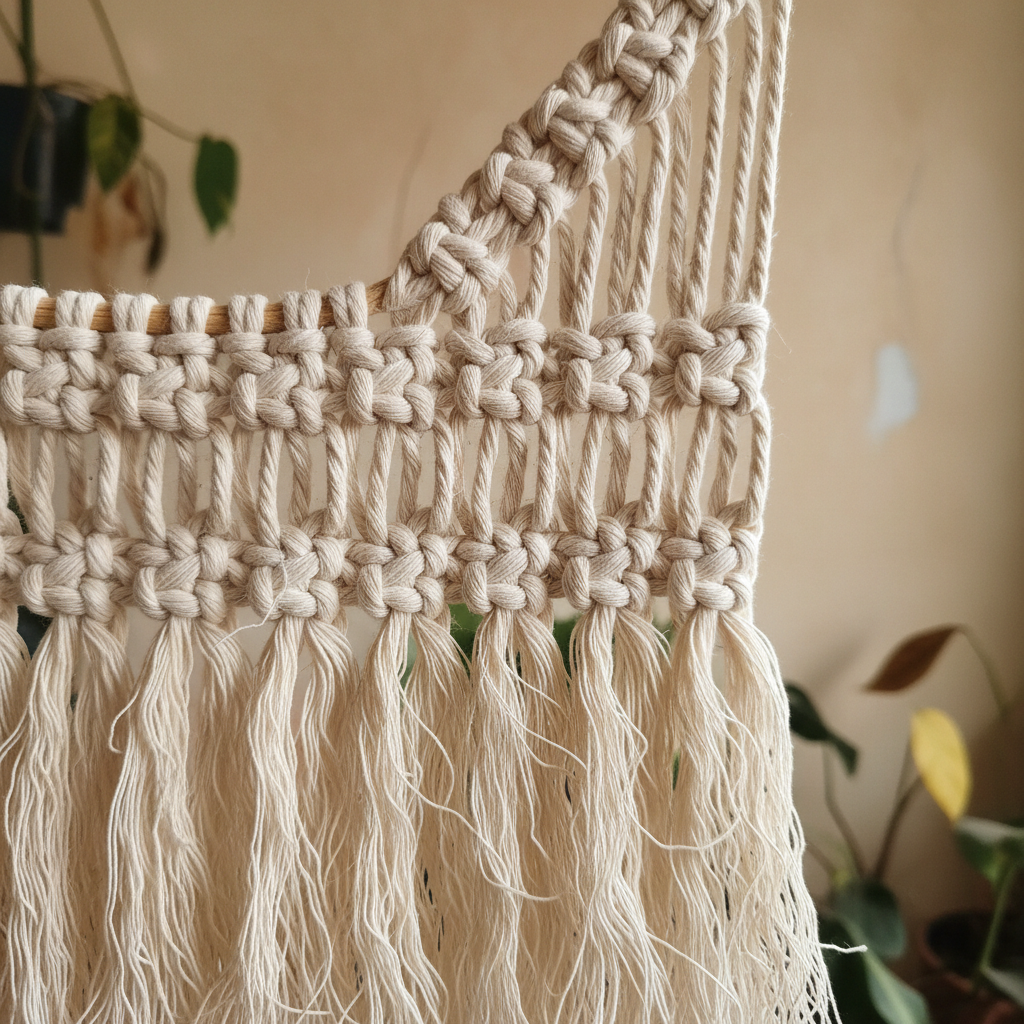
Square knots, double half hitches worked in diagonal lines and gathering knots all arrived correctly, because each was described by the shape it forms as well as by its name. The one knot that failed is the spiral: long runs of half knots twisting steadily down came back as short clusters with almost no twist, because the instruction named the knot and the direction but never described what a spiral looks like once it is worked. Describe the surface, not the notation.
How It Works
Pick the project
Six presets: a large fringed wall hanging on a driftwood dowel, a spiral half knot plant hanger holding a terracotta pot, a doorway curtain knotted into an open net and used as a room divider, a thick rope hanging chair with a fanned back, a fine table runner on reclaimed oak, and an extreme close-up of square knots and diagonal half hitches. Each already carries the camera height, the handmade tension and the text ban.
Add your cord, your knots and your wall
Put the specifics in the box: the finished width and drop, the cord colour and whether it is three-ply twisted, single twist or braided rope, which knots you want and in what order down the piece, how deep the brushed fringe is and how it is cut, what the work hangs from, and what is behind it. The wall and the dowel are what give a hanging its scale, so they matter more than the knot names.
Check it, then download
About thirty seconds later you have the piece. Before you judge it, check three things on a zoomed crop: are the knots you named actually the knots in the picture, has the fringe kept the uneven handmade edge you asked for or been tidied into a ruler-straight line, and has any letterform crept into the cords or the gaps between them. Then download at up to 4K.
Writing a Prompt That Produces Believable Macrame
Four habits that separate a hanging you could actually knot from one you regenerate, all learned from the six results above.
Name the knot and the shape it makes
A knot name on its own is weak; a knot name plus the shape it forms is strong. A broad band of square knots across the top, a diagonal lattice of crossing double half hitch lines opening into diamonds, a long run of half knots twisting into a spiral. Said that way the structure arrives. Cord counts, row counts and pattern notation do not survive the trip, so describe what the finished surface looks like instead.
Ban the word as a shape, not just as text
Real macrame spells things — names over cots, a word above a bed — so this subject is primed to put letterforms into the cords. A general no-text instruction is measurably weaker than refusing the carriers one at a time: no word formed in the knots, in the fringe or in the gaps between the cords, and no chart, sheet, sign, book or tape measure anywhere in the room.
Ask for the handmade failures by name
Cord is the easiest material on this site to render into plastic. What keeps it fibrous is naming specific imperfections in specific places: stray fibres standing out of the ply, one knot a fraction looser than its neighbours, a fringe combed uneven and kinked where it was brushed, a cord marked grey where it has been handled. A general request for a handmade look is ignored.
Light it from the side
Macrame is a relief surface, and flat frontal light flattens it into a texture swatch. Raking side light makes every knot throw its own small shadow onto the cords behind it, which is what tells the eye the piece is three-dimensional. Saying where the light comes from and that the fringe casts a soft striped shadow beneath it does more for the picture than any amount of cord detail.
Who Uses an AI Macrame Pattern Generator
Makers planning a piece before cutting cord
Cord is cut at roughly four times the finished drop, which means a wall hanging that turns out badly proportioned has already eaten a whole reel. Seeing the proportions, the fringe depth and the knot layout on a wall first is ten minutes against an afternoon of unpicking.
Etsy and craft-fair sellers testing designs
The decision that matters is which three designs to knot for a fair, and that is a visual judgement made before any of them exist. Generating a dozen variations of width, colour and fringe style shows which ones read from across a stall.
Interior stylists speccing fibre art
A hanging is specified by the gap it has to fill, not by its knots. Generating the same piece at three widths against the actual wall colour settles the scale question with a client far faster than a supplier photograph on a white background.
Teachers and workshop hosts
A workshop needs a finished example to show before anyone signs up, and photographing one means knotting one. A generated piece covers the listing image and the handout illustration while the real sample is still on the rail.
Anyone matching a piece to a room
Cream against warm plaster, black cotton against a pale wall, jute in a dim alcove — cord colour behaves completely differently depending on what is behind it and where the light comes from. That is the cheapest thing to test here and the most expensive to get wrong.
Plant people with a bare ceiling hook
The plant hanger preset exists for the specific question of how long the drop should be and how low the cradle should sit, which is impossible to judge from a flat product photo and obvious the moment you see the pot hanging in the alcove.
AI Macrame Pattern Generator FAQ
Related Craft Tools
AI Crochet Pattern Generator
The same design-before-you-buy-yarn problem in a different craft — graphgan blankets, amigurumi and granny squares, with the stitch structure described the same way the knots are here.
AI Knitting Pattern Generator
Colourwork charts, cable panels and garment shapes. Worth generating alongside if you are deciding which craft a wall piece or a throw should be made in before committing to either.
AI Wall Art Generator
What a hanging usually competes with for the same wall. Generate both and you can see whether the gap above the sofa wants fibre and shadow or something flat and framed.
See the Hanging Before You Cut Forty Metres of Cord
Six projects — a fringed wall hanging, a spiral plant hanger, a doorway curtain, a hanging chair, a table runner and a knot close-up — each photographed in your cord, at your proportions, on your wall, in about thirty seconds. Up to 4K. Free to start, from $2.99.
Design a Macrame Piece FreeAn AI Macrame Pattern Generator for Proportions, Knots and Fringe You Can Actually See
Macrame is unusually unforgiving for a craft with only three or four knots in it. The cord is bought by the reel and cut at roughly four times the finished drop, the pattern only becomes visible after several hours of knotting, and the one thing that decides whether a piece looks good — its proportion against the wall it hangs on — is invisible until it is hanging there. That is the gap an AI macrame pattern generator fills. Describe the project, the cord, the knots in the order they run down the piece, the depth of the fringe and the wall behind it, and about thirty seconds later you have a photograph of it hanging. Every preset on this page is written that way, and the six results above are published exactly as they came back, drifts included.
The six projects cover what people actually make. A large fringed wall hanging on a driftwood dowel, with a band of square knots opening into a diamond lattice of double half hitches. A jute plant hanger worked in spiral half knots, holding a ribbed terracotta pot low in a plaster alcove. A doorway curtain knotted into an open net and used as a room divider. A thick rope hanging chair with a fanned back and a long shaggy fringe. A fine table runner down a reclaimed oak table. And an extreme close-up of the knots themselves, for anyone who wants to see how the cord is actually constructed before they try to copy it. Between them they cover flat and three-dimensional, fine cord and thick rope, and the full range from an evening with a reel to a project that needs a ceiling fixing.
Macrame turns out to be a demanding subject for an image model for two specific reasons. The first is text: real hangings very often spell a name or a word in the knots, so this is the rare subject where the model is actively primed to form letters out of the structure of the thing itself. The fix that works across this series is to refuse the carriers one by one rather than to ask for no text in general — no word formed in the knots, in the fringe or in the gaps between the cords, and no chart, sheet, sign, book or tape measure anywhere in the room. The second is material. Cord renders into clean plastic cable unless its failures are named, so every preset asks for stray fibres, uneven combing, inconsistent tension and a cord marked where it has been handled.
The rest is detail that any fibre-art prompt benefits from. Knots should be named together with the shape they make, because the name alone is too weak and the notation is too precise to survive. Scale should be set by what the piece hangs from and what is behind it, not by millimetres of cord diameter. Light should rake across the work from one side so the relief reads. And the room should be a real room with a hairline crack in the plaster and worn paint in the grain of the architrave, because a hanging floating on a flat white background is the most catalogue-like thing you can produce. Within those limits an AI macrame pattern generator is a genuinely good way to spend twenty minutes before you cut forty metres of cord into lengths you cannot join back together.