
AI Christmas Lights Design Generator
Christmas lights are bought in daylight in a shop and judged at night from the pavement, which is why so many displays turn out to be three good ideas fighting each other. This AI Christmas lights design generator closes that gap: upload a daytime photo of the front of your house, pick a scheme, and about thirty seconds later the same house comes back photographed at dusk with the display lit — before you buy a strand, climb a ladder or run a single extension lead.
Light Up Your House FreeTry the AI Christmas Lights Design Generator — Free
Upload a daytime photo taken square-on from the pavement, with the whole front of the house in frame and nothing parked across it, then pick a scheme. Each preset already carries the blue-hour light that makes bulbs emit instead of glowing flatly, the instruction to leave your architecture untouched, and the itemised refusal of signs, plaques, house numbers and words spelled in bulbs that produced the six pictures below.
AI Christmas Lights Design Generator
Upload a daytime photo of your house, choose a lighting scheme, and see it lit at dusk. Up to 4K.
Upload a daytime photo of the front of your house, shot level and square-on, then pick a scheme and generate
Six Displays From the AI Christmas Lights Design Generator, Shown Exactly As They Came Back
Nothing here was retouched. These six were generated from written descriptions of the same schemes the presets apply to your photo, and the captions say what was asked for, what arrived and what drifted — which is the part most pages like this leave out.
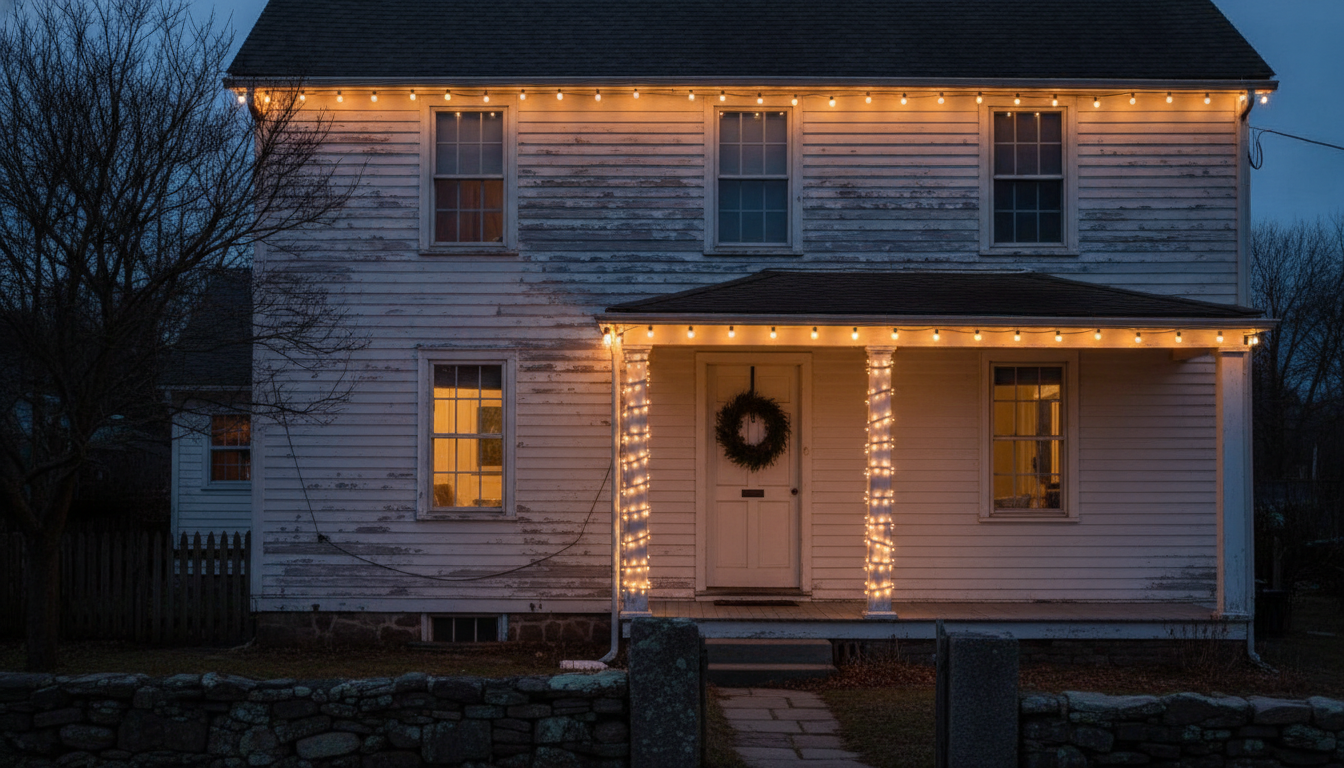
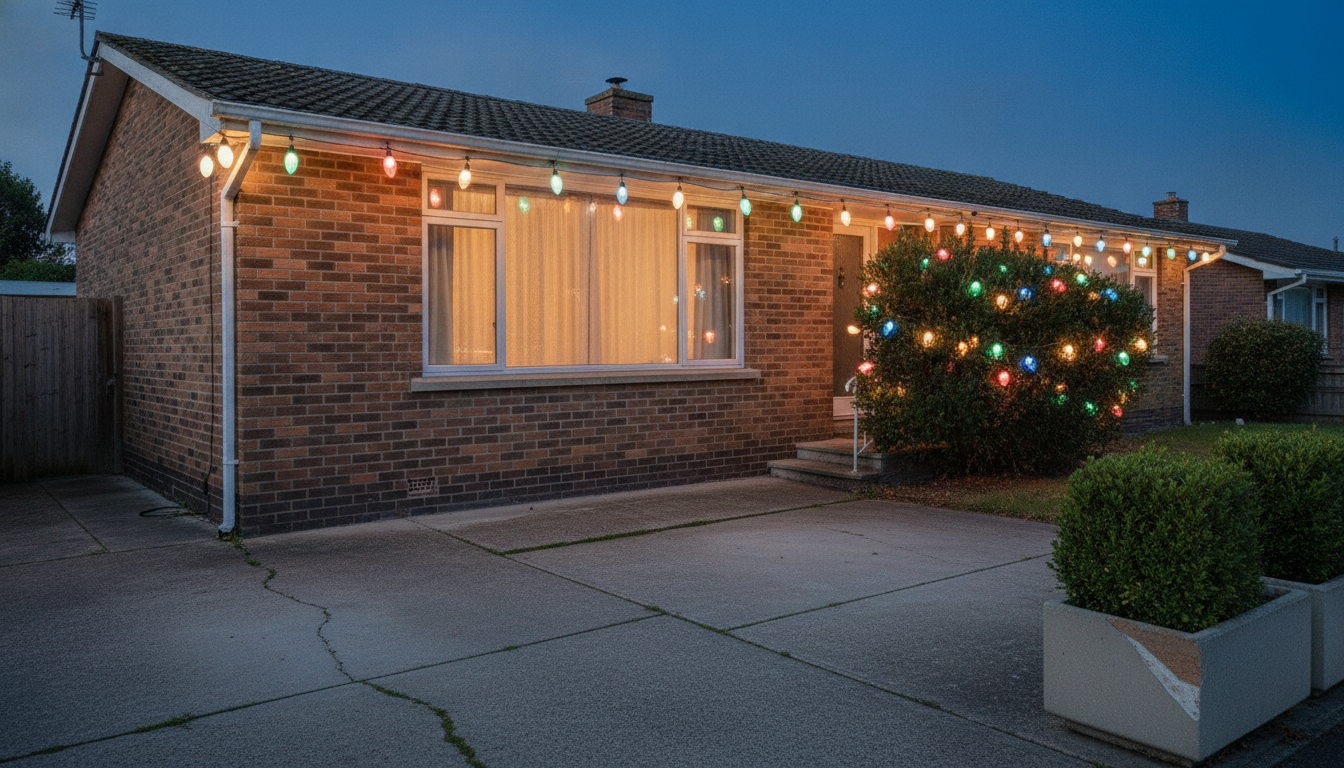
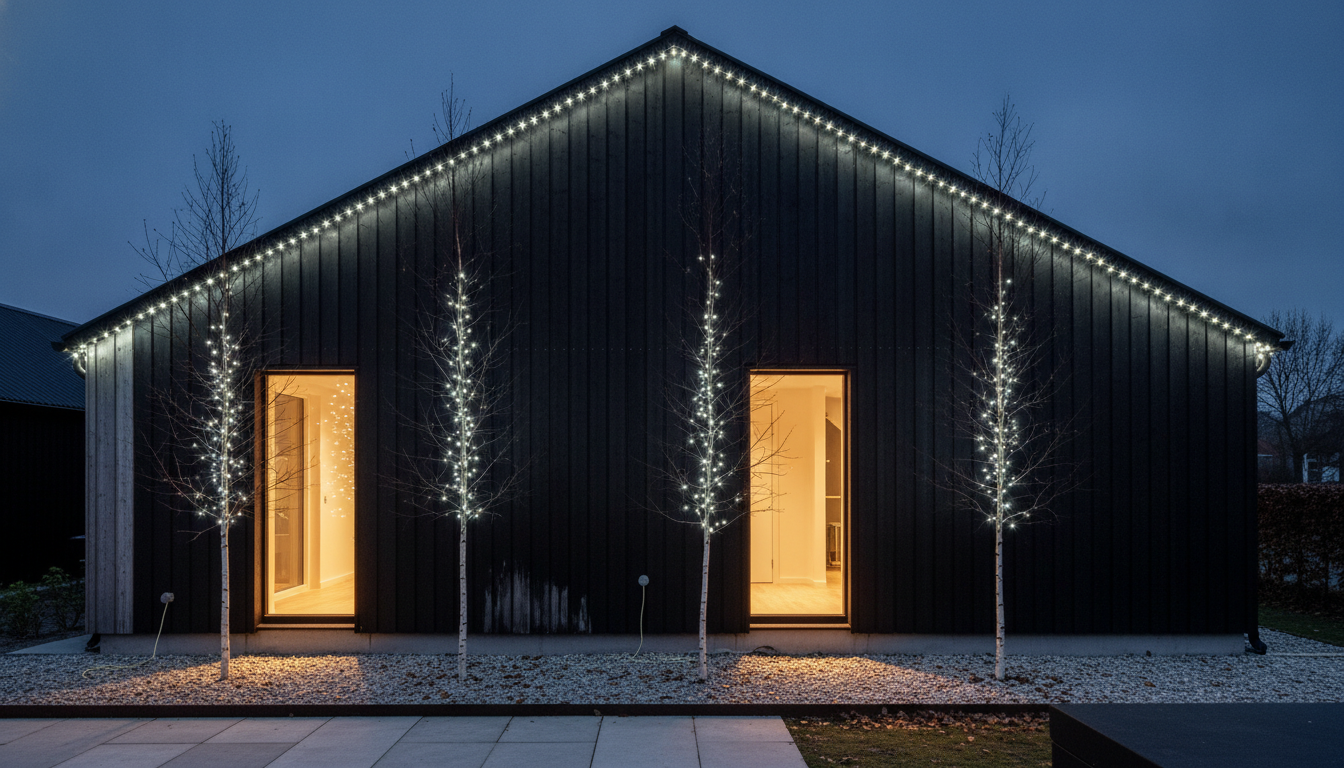
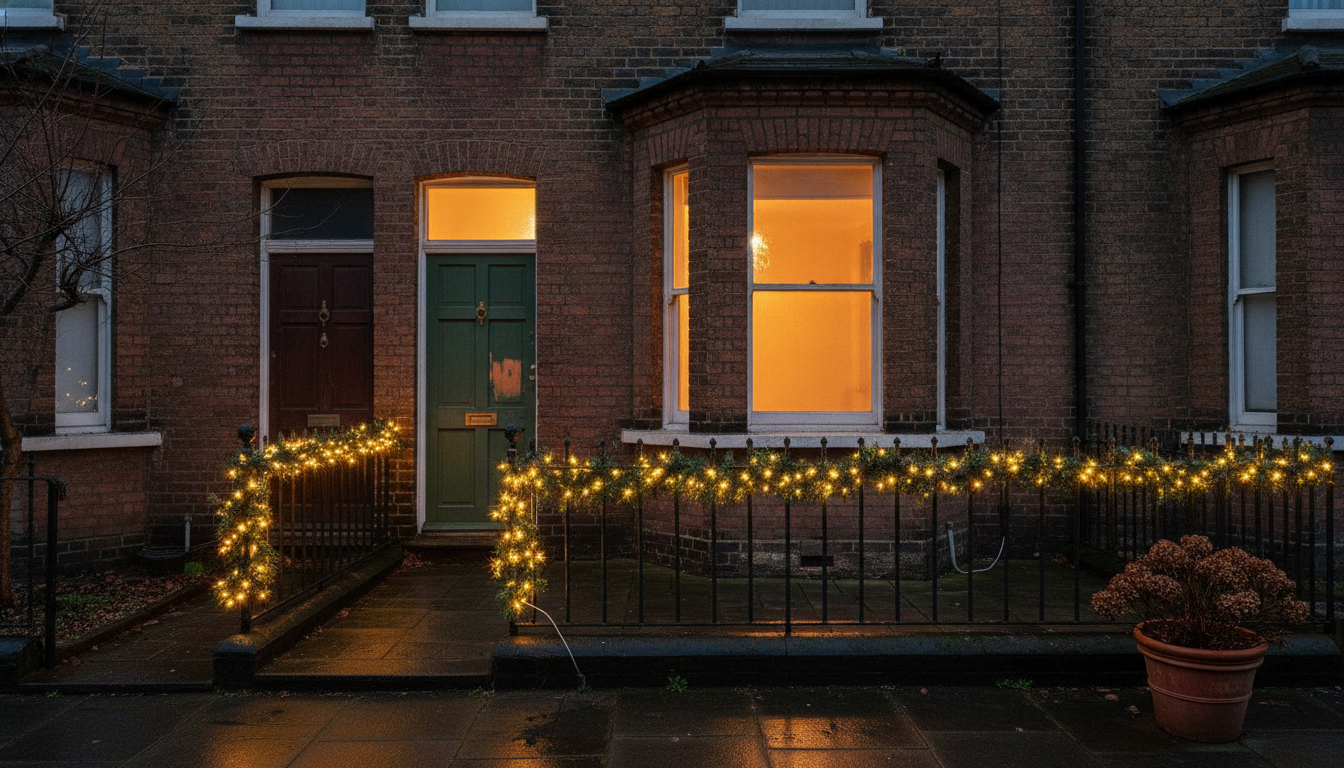
What the AI Christmas Lights Design Generator Gets Right and Wrong
A light display is a repeated object, photographed in the dark, on a building that carries a number in real life. Almost everything these six frames teach comes out of those three facts.
Six out of six clean, after one rerun caused by a plaque
A house front carries a number in real life and a light display is the thing most likely to spell a greeting, which makes this subject about as text-prone as it gets. At full zoom there is no lettering on any of the six frames: no house number, no sign, no word in bulbs, nothing on the letter plates, the air brick, the wheelie bin or the log store. It took one rerun. The Victorian terrace first came back with a small oval plaque beside the door carrying a garbled half-number, even though the ban listed "a plaque" by name. What cleared it was naming the object by its shape — oval plaque, roundel, disc, medallion — and then describing the brickwork positively as bare with nothing fixed to it. A generic noun in a ban is weaker than the shape the model is actually drawing.
Naming what must be out of frame held the close-up again
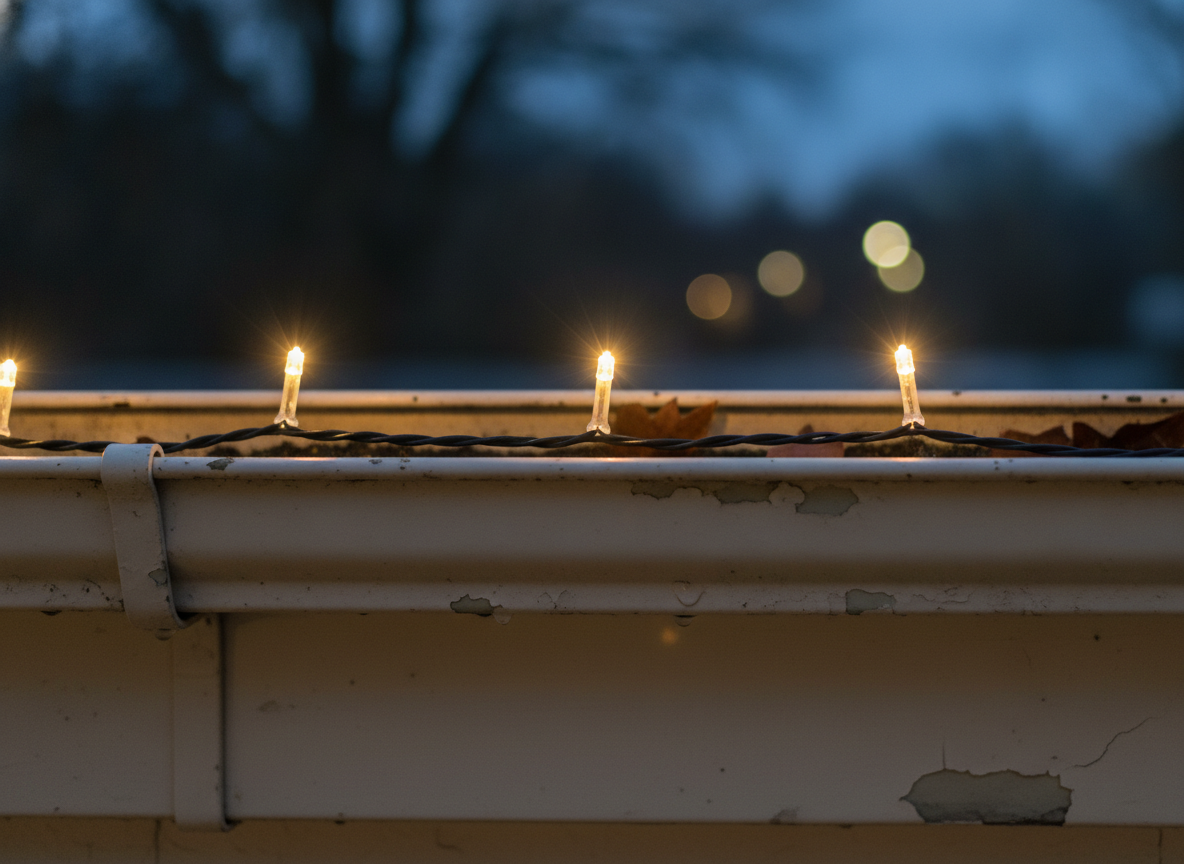
Macro shots on this site have a long history of quietly retreating by one order of context: a bark close-up that included the whole pot and bench, a branch tip that included the skirting board. The gutter macro here stayed on the gutter — no wall, no roof, no window, no street — and the only reason is a clause listing what had to be outside the picture. That is now two runs in a row, which is enough to treat it as a rule rather than a lucky frame: describe the crop positively and then name the excluded context explicitly.
The clause that stops lights spreading can eat the one light you wanted
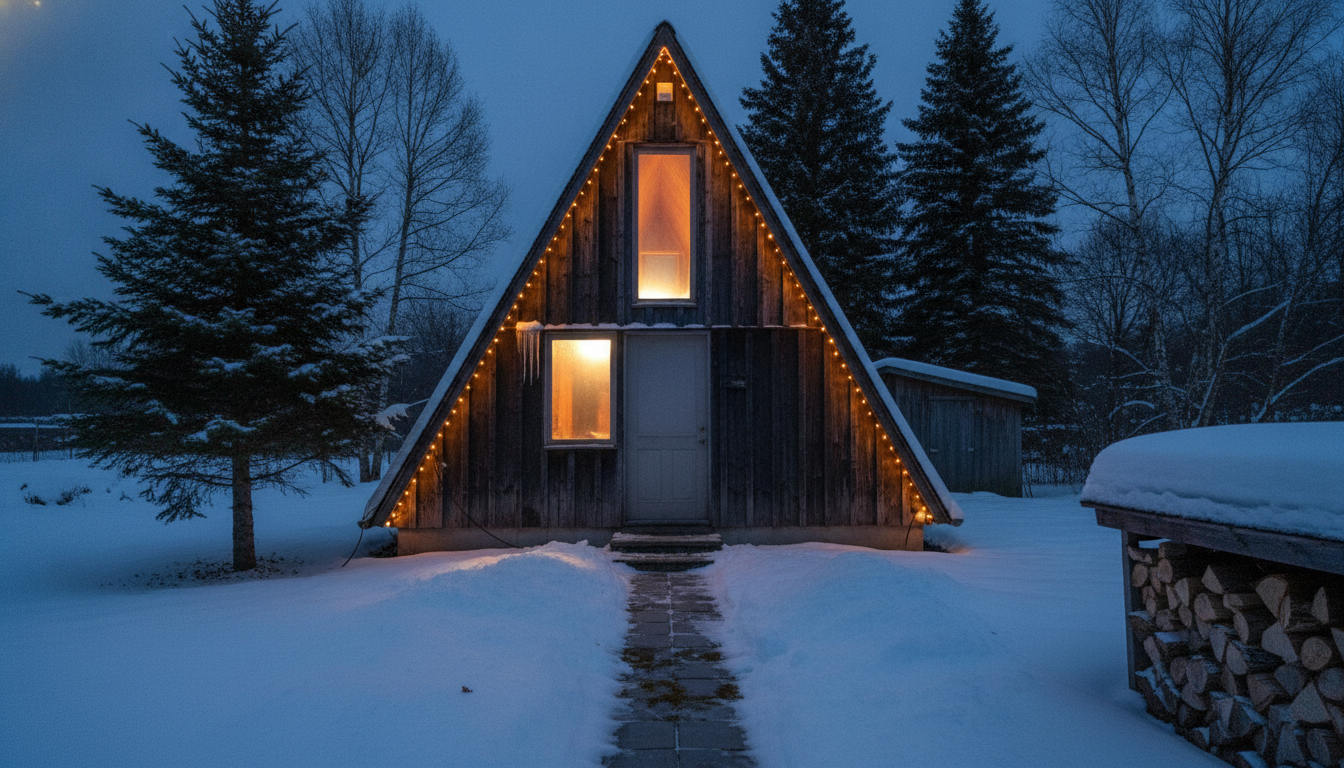
Lights are the most spreadable decoration there is, and the fix that works is to name the carrier and then state that everything else stays bare and unlit. It held on five frames — dark window frames, dark fences, a completely unlit maple. On the snowy cabin it overshot: the single spruce that was supposed to be wound with bulbs came back as bare as the three behind it. The negative sweep is strong enough to overrule a positive instruction in the same sentence, so when a scheme has exactly one exception, state the exception twice — once as the thing that is lit, once as the thing excluded from the sweep.
Anything repeatable still drifts upward
Three birch trunks were asked for in front of the modern house and five arrived, each neatly wound with lights. This is the same failure as the bonsai training wire that multiplied from one to five and the soft items that drift upward in number: a decorative element that could sit on any of several identical carriers tends to sit on all of them. Structural counts — two porch columns, one gutter run, one door — held perfectly across all six frames. Count anything decorative at full zoom before you trust the picture, and expect the display to be slightly larger than you described.
Square-on holds until the building is too long for it
Five of the six frames obeyed a level, face-on camera at standing eye height with the whole elevation in shot and something low cut by the frame edge — the drystone wall, the concrete planter, the stone slab, the terracotta pot, the log store. The exception is the long single-storey ranch, which swung to a three-quarter view, because a wide low building simply will not fit a face-on frame at pavement distance. Useful to know before you upload: a long house will be photographed at an angle whatever you ask for, so shoot your own reference from the angle you want and let the generator keep it.
Bulbs are rendered as light, and broken paint behaved for once
The physics is the strongest part of this subject. Asked for a hot core with a soft bloom, warm pools spilling down the wall and faint halation where a strand crosses something dark, the model delivered all three on every frame, plus the orange spill of a bay window across wet flagstones and warm pools in snow. The standing problem of damage arriving as one tidy island also broke the right way here: the gutter macro's flaking cream paint appears in several separate places and genuinely runs off both edges of the frame, which is the clearest result yet for the "ask for the decay to run off the frame" fix.
How It Works
Photograph the house in daylight
Stand on the pavement, hold the camera level at eye height and shoot the front square-on with the whole house in frame from the ridge to the ground. Overcast is better than bright sun, nothing parked across the front, and no extreme wide angle — a lens that bends the walls will bend the light runs with them.
Pick the scheme
Six presets: a classic warm white roofline with wrapped columns, retro multicolour big bulbs along the gutter, a single minimal run of cool white pin lights, an icicle fringe hanging from the eaves, a lit evergreen garland along the railings and door, and wrapped trees and shrubs with the building left dark. Each one states where the lights go and that everything else stays unlit.
Check it, then download
About thirty seconds later your house comes back at dusk. Before you judge it, check three things at full zoom: has any lettering appeared on a door, a plaque or a wall; did the lights stay on the carriers you asked for instead of spreading; and are the architecture and the camera angle still yours. Then download at up to 4K and take it to the roof line with a tape measure.
Writing a Prompt That Produces a Believable Light Display
Four habits that separate a display you could actually hang from one you regenerate, all learned from the six results above.
Name the carrier, then close the door
Lights are the most spreadable thing you can ask for: name one run and the model will happily light the windows, the fence, the chimney and the hedge as well. What stops it is saying where the lights are and then saying that everything else stays bare and unlit, item by item. Festive, magical and tasteful are the three weakest words you can type — a gutter line, a wrapped column, a fringe hanging from the eaves and a strand threaded inside a garland are four things it can actually draw.
Ask for dusk, not for night
A full-black sky gives you floating dots and a house you cannot see. The blue hour keeps the brick, the paint and the planting readable while the bulbs are fully lit, which is also how every good photograph of a real display is taken. Say the sky is deep blue rather than black, ask for a hot core with a soft bloom around each bulb, for warm pools spilling down the wall under each run, and for light from the windows falling on the ground outside.
Refuse every carrier of writing by name
A house front carries a number in real life, which makes it one of the most text-prone subjects there is. A general no-text instruction is measurably weaker than listing the carriers one at a time — house number, number plaque, nameplate, oval plaque, roundel, disc, light-up sign, rope-light word, banner, yard sign — then describing the door and the brickwork positively as plain and bare with nothing fixed to them, and finally banning a letter formed by the bulbs themselves.
Let the house be lived in
The giveaway of a rendered display is that the cable is invisible and the wall is perfect. Real lights sag between their clips, turn one corner awkwardly and run down to a socket along the ground. Ask for that, then give the building its ordinary wear — paint lifting along a board edge, a water stain under a gutter joint, moss in the paving joints, a crack across the drive. Those details do more for realism than any number of extra bulbs.
Who Uses an AI Christmas Lights Design Generator
Anyone decorating their own house
The whole display is bought in one trip and judged from the pavement six weeks later. Seeing warm white against multicolour on your own brick, and finding out that the roof line alone is already enough, is twenty minutes against a loft full of strands you never hang again.
Households settling an argument
Warm white or colour is the oldest Christmas argument there is, and it is unwinnable in a shop aisle. Two pictures of the same house, same angle, same dusk, settle it in a minute — and usually reveal that the real disagreement was about how much, not about which colour.
Installers quoting a job
A lighting installer quoting in October is selling something the customer cannot picture. Sending back the customer's own house with the proposed scheme lit, at the angle they see it from, closes jobs that a product photo and a price per metre do not.
Landlords, shops and small businesses
A shopfront or a rental has to look decorated without looking chaotic, usually with no drilling and one accessible socket. The restrained presets hang everything off a single carrier — a rail, a frame, a fascia — which is a realistic brief rather than an aspirational one.
Neighbourhood and street displays
Streets that decorate together need agreement before anyone buys. Generating three or four houses in one shared scheme shows what a whole terrace or cul-de-sac reads like from the end of the road, which is the only view that actually matters.
Photographers and set designers
A Christmas shoot is planned in autumn with nothing built. Generating the frame first — which lines are lit, how much the bulbs bloom, where the warm pools fall on a wet pavement — settles the rig list and the shot before a single strand is hired.
AI Christmas Lights Design Generator FAQ
Related Tools
AI Exterior Design Generator
The same upload, the rest of the year. Paint, siding, windows and curb appeal on the daylight photo you already took for the lights.
AI Christmas Tree Design Generator
The inside of the window the lights are seen from. Worth running in the same warm or cool white you picked outside so the two do not argue.
AI Wreath Design Generator
Design the door wreath on its own — greenery, scale and finish — then carry the winning one into a garlanded porch prompt here.
See the Display Before You Buy the Lights
Six schemes — warm white roofline, retro multicolour big bulbs, minimal cool white, icicle fringe, garlanded door and railings, and wrapped trees — put on a photo of your own house and lit at dusk in about thirty seconds. Up to 4K. Free to start, from $2.99.
Light Up Your House FreeAn AI Christmas Lights Design Generator for a Decision Made in Daylight
Outdoor Christmas lights are the only piece of decorating that is chosen under shop strip lights, hung on a cold afternoon up a ladder, and then seen almost entirely in the dark from forty feet away. Nobody gets to preview that. The result is the familiar November pattern: a box of warm white, a box of multicolour, a set of icicles bought because they were on the end of the aisle, and a front elevation that ends up with three different ideas on it. An AI Christmas lights design generator exists to close that gap. Upload a daytime photo of the front of the house, pick a scheme, and the same house comes back photographed at dusk with the display lit, at the angle you actually see it from, in about thirty seconds.
The six schemes on this page are the six real decisions. A classic warm white roofline with the porch columns wrapped, which is the safe answer and still the most convincing one on a painted timber house. Retro multicolour big bulbs along a gutter, which look nostalgic on brick and cheap on render, and this is the fastest way to find out which one you have. A single run of cool white pin lights on a modern building, where the restraint does the work. An icicle fringe, which is the scheme most dependent on a straight eaves line. A lit evergreen garland along railings and the front door, where the light comes from inside the greenery. And wrapped trees and shrubs with the house left completely dark, which is the scheme most people never consider and the one that photographs best in snow.
Two things make a light display a demanding subject for an image model. The first is that lights spread. A strand is a repeatable decoration, so naming one run invites the model to light every other surface that could carry one — the windows, the fence, the chimney, the hedge. Every preset here answers that by naming the carrier and then stating that everything else stays bare and unlit, which works, though in one of the six frames the sweep went too far and left a tree that was supposed to be lit completely dark. The second is text. A house front carries a number, a nameplate or a plaque in real life, and a light display is the one thing in the world most likely to spell a greeting, so the model arrives heavily primed to invent lettering. Refusing each carrier individually by its actual shape — including the oval plaque that beat the first attempt at the Victorian terrace above — works far better than asking for a picture with no writing in it.
The rest is ordinary craft. Ask for dusk rather than night, because a black sky leaves floating dots and a house you cannot read. Ask for the physics of a bulb — a hot core, a soft bloom, warm pools spilling down the wall, a faint halation where a strand crosses something dark — rather than for a festive atmosphere. State a count and then check it, because anything repeatable drifts upward: three birch trees came back as five. Keep the camera honest, level and square-on from the pavement, which is where the display is actually judged from. And let the installation be real, with cable sagging between its clips and one length running down to a socket, because a display with no visible wiring is the clearest sign that nobody ever hung it. Within those limits an AI Christmas lights design generator is a genuinely useful twenty minutes in October, and a far better guide than the picture on the box.