
AI Christmas Stocking Generator
A stocking is a small decision you have to make early and then live with on the most looked-at shelf in the house. This AI Christmas stocking generator turns a description — the cloth, the cuff, the toe, the colours, the hook it hangs from — into a finished stocking photographed in a real room in about thirty seconds, so you can compare crimson velvet against a Fair Isle knit against plain linen before you buy a set of five or cast on in October.
Design a Stocking FreeTry the AI Christmas Stocking Generator — Free
Pick a style, then use the box for what is specific to yours — the cloth and its nap or weave, the length, whether the toe is pointed or squared, how deep the cuff is and what it is made of, your two or three colours, the hanging loop, and what it hangs from: a mantel hook, a banister, a bed end, a row of nails. Each preset already carries the level camera that keeps the whole stocking in frame, the wear detail that stops cloth looking moulded, and the itemised ban on tags, labels and monograms that produced the six pictures below.
AI Christmas Stocking Generator
Choose a style, name your cloth, cuff and colours, and get a photorealistic Christmas stocking hung in a real room. Up to 4K.
Six Stockings From the AI Christmas Stocking Generator, Shown Exactly As They Came Back
Nothing here was retouched. The captions say what the prompt asked for, what arrived and what drifted — which fabrics the model really knows, what happens to a two-colour knitted pattern at small scale, and how an object that is monogrammed in real life behaves when you refuse it every kind of lettering.
What the AI Christmas Stocking Generator Gets Right and Wrong
A stocking is a soft object that hangs, is made of one or two fabrics at close range, and is personalised with a name in real life. Nearly everything these six frames teach comes out of those three facts.
Six out of six clean, on the object whose job is to carry a name
A stocking is the one Christmas decoration that exists to be monogrammed, so the model arrives heavily primed to invent a name, a care label, a woven tab or a lettered holder. Not one of the six frames has a mark on it, checked at full zoom on the cuffs, the hooks, the hanging loops, the bucket rim and the chipped rail. The stack that did it is the one this site has been building for months: refuse each carrier individually rather than asking for no text, describe the surface positively as plain and completely unmarked from cuff to toe, and ban a word being formed in the stitches, in the pile or in the gaps between the stockings. The props were covered by the same clause this time — plain bare logs, an unmarked bucket, a chipped concrete planter — and none of them grew a maker's label.
Velvet is the one fabric it will not give you
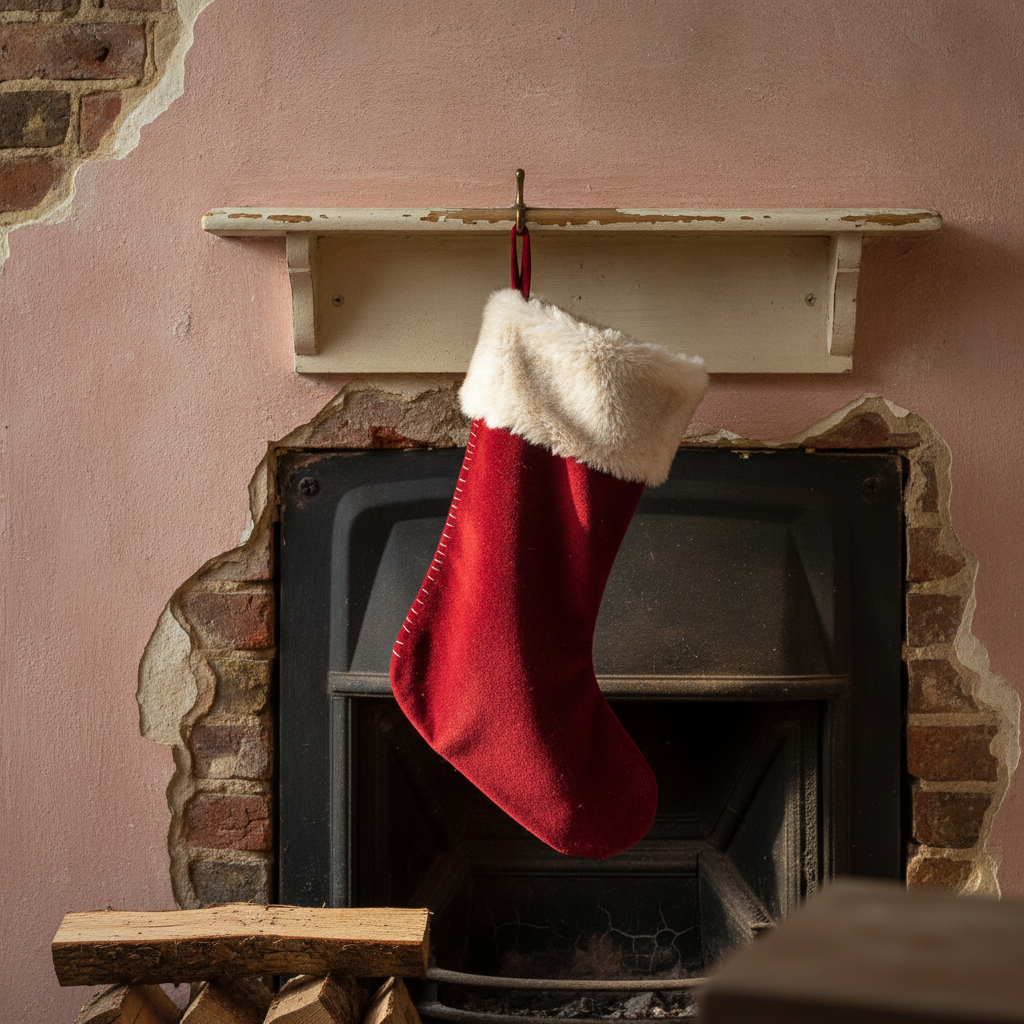
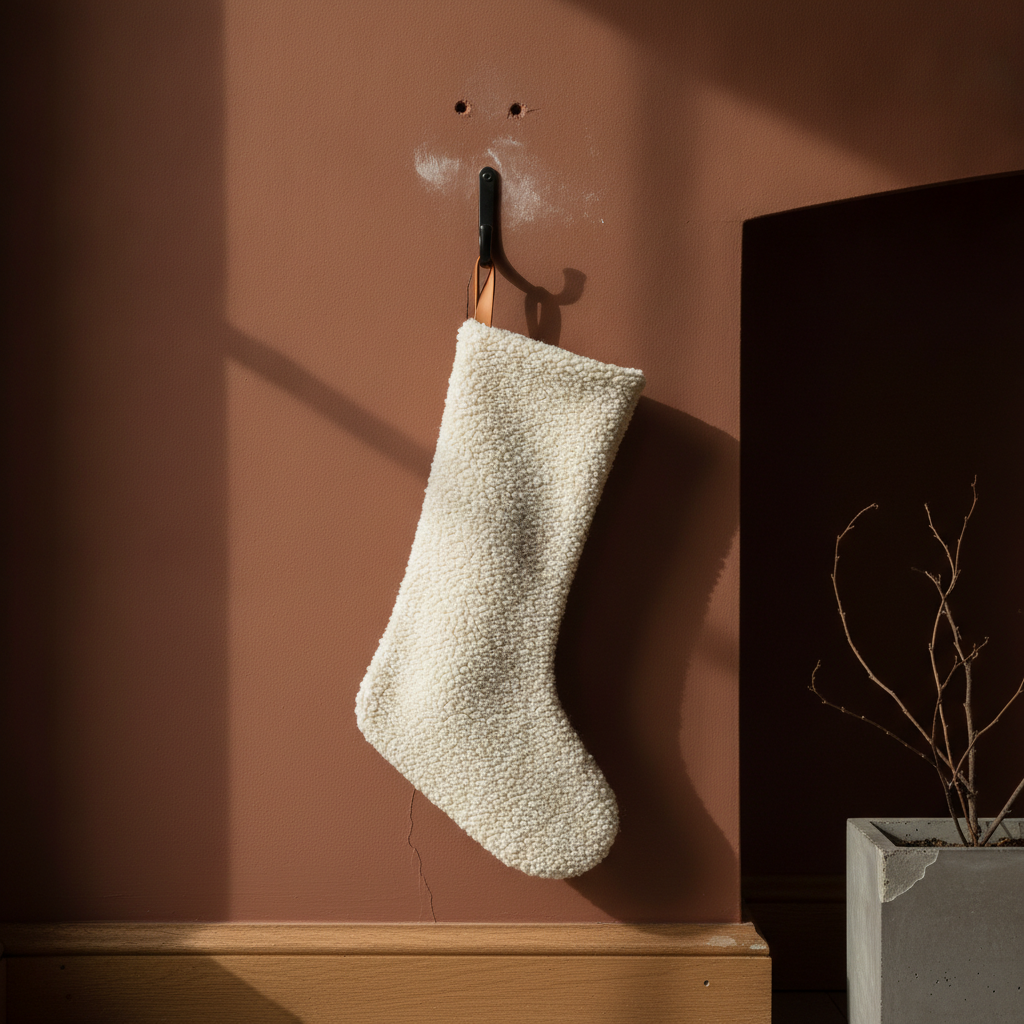
Crimson cotton velvet was asked for twice, in two different frames, described each time by what the nap does in light. Both came back as matte brushed wool with no sheen and no direction to the pile. Everything else landed: boucle as a field of tiny loops, slubby flax linen, hand-knitted wool with uneven tension, machine-even cable knit, and faux fur that reads as fur rather than plastic. The lesson is not to avoid velvet but to describe the light instead of the cloth — where the highlight runs, which way the pile lies, where it goes dark when it bends — because the material name alone resolves to generic red fabric.
A named motif loses to the style's own motif
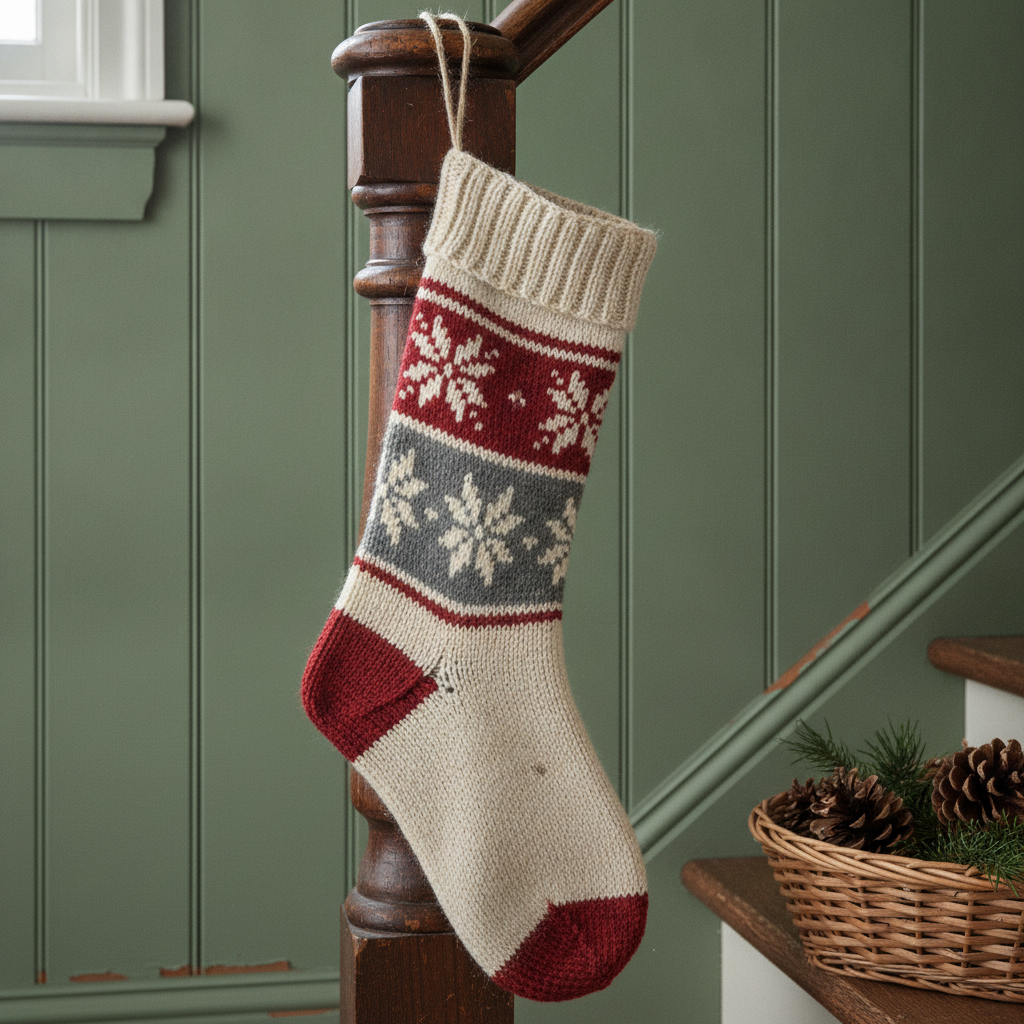
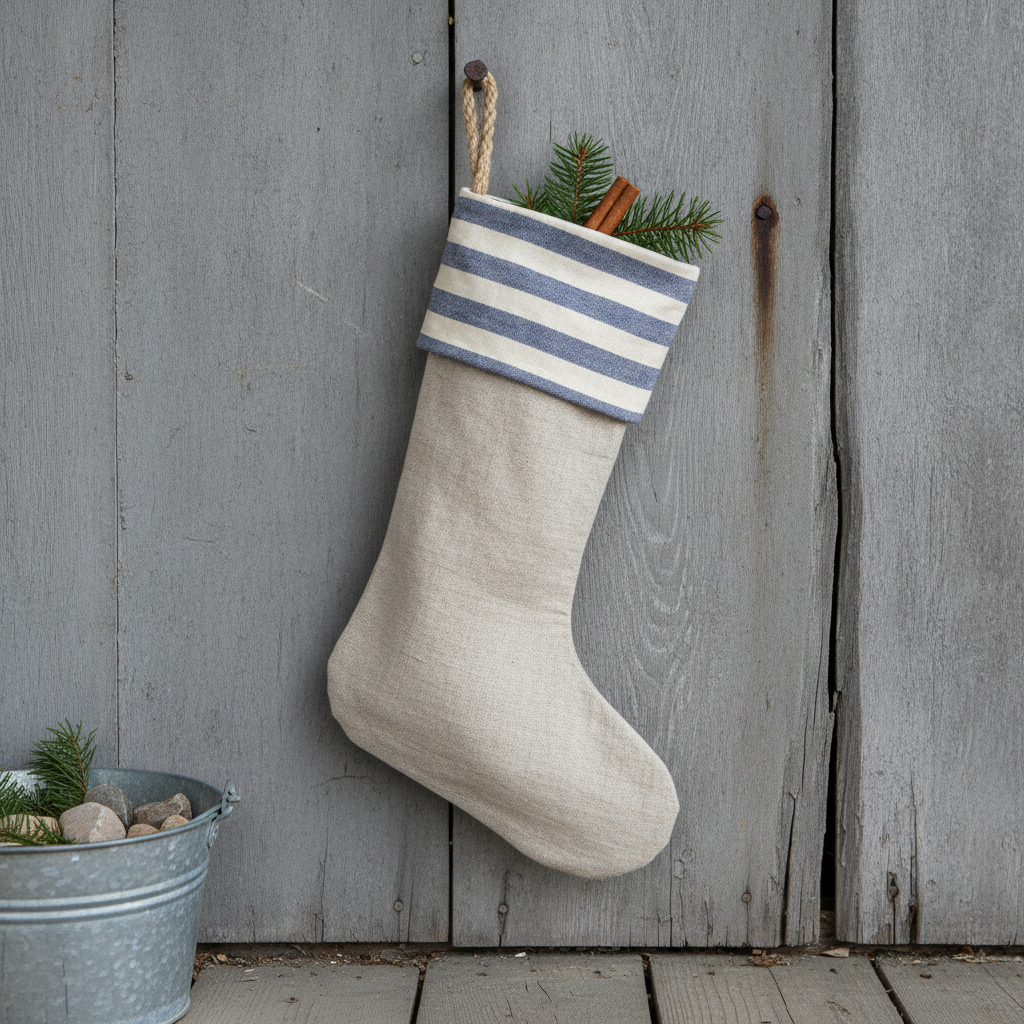
The Fair Isle frame asked for two different patterned bands: large eight-pointed stars in the red one, big plain diamonds in the grey one. Both came back as snowflakes. The ticking cuff asked for cream bands twice the width of the indigo ones and came back with stripes of equal width. This is the same failure as a two-colour check collapsing to one colour in an earlier run, and it narrows it usefully: small repeated patterning resolves to whatever that style normally looks like, so if the motif matters, it has to be the subject of the picture rather than a band across it.
A row holds its count and its order, but not its variation
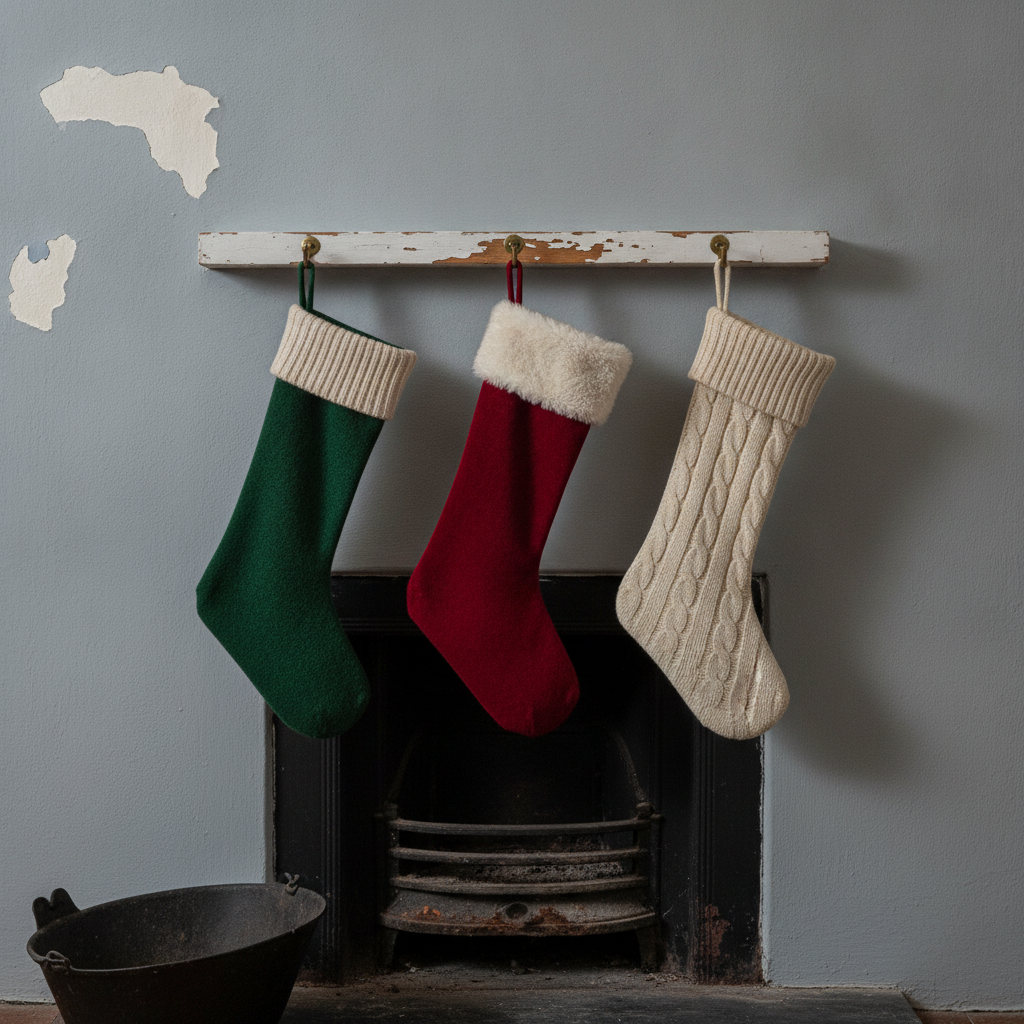
Three stockings were asked for on three hooks, each a named fabric with a named cuff, counted from the left. Three arrived, correctly spaced, with the right fabric and the right cuff on each one in the right order — the strongest enumeration result this site has had, and better than expected given that soft items usually drift upward in number. What failed is the one deviation asked for: one of the three was to be turned slightly so its side showed, and all three hang perfectly flat. It is the repeated-unit rule again. You can specify the members of a row and you cannot specify how one of them differs.
Naming what must be out of frame finally beat the pull-back
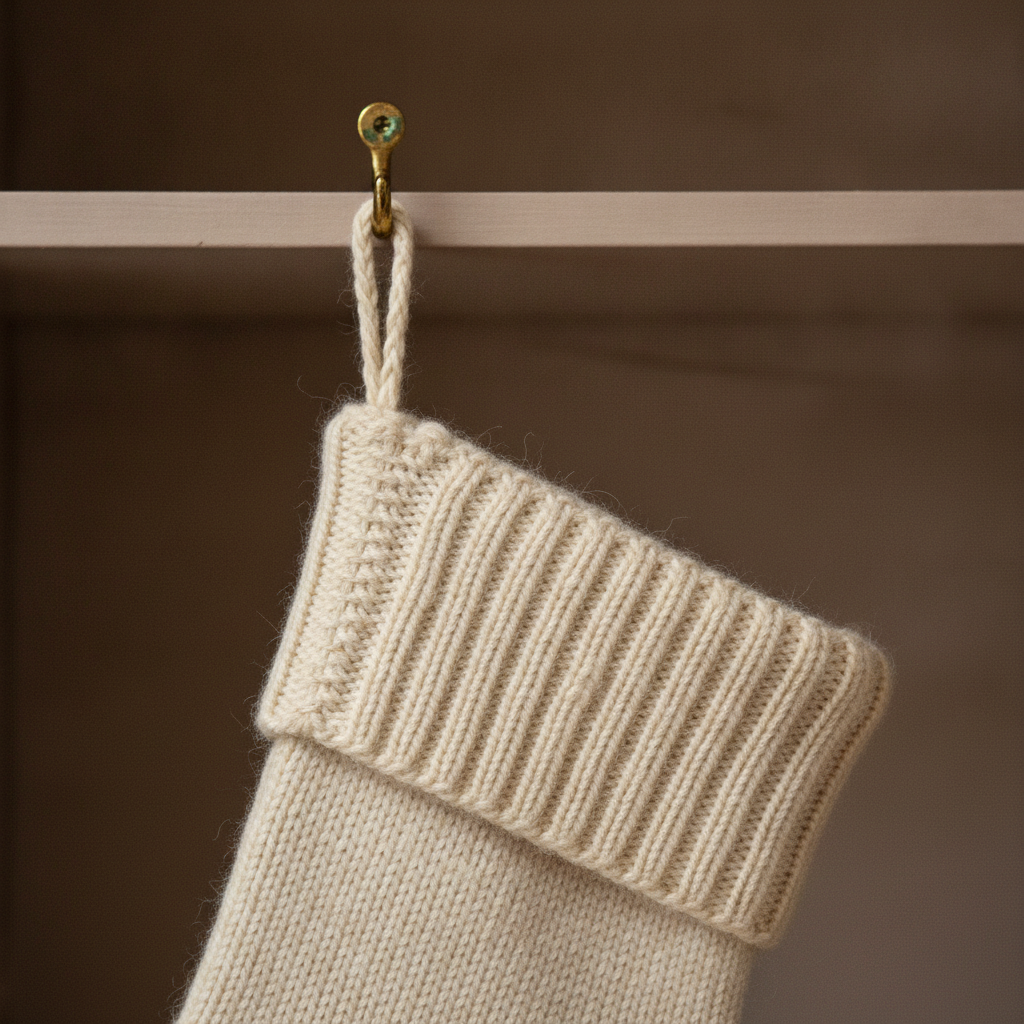
Every extreme close-up in this series has quietly retreated by one order of context — a bonsai bark macro that included the whole pot and bench, a branch-tip macro that included the skirting board. This one did not. The difference is a single clause listing what had to be outside the picture: the fireplace, the shelf top, the hearth, the floor and any wall. Describing the crop positively is not enough on its own; naming the excluded context is what holds it. That is the most portable finding of the run and it should go into every macro prompt from here.
Damage runs off the frame about half the time
The standing fix for decay arriving as a tidy island — ask for it to run off the edges of the frame and appear in several places — was tested twice here and split. The velvet frame's lime plaster broke open in two separate places, one running off both the top and the left edge, which is genuine decay rather than a framed patch. The row frame's flaked paint came back as two neat white islands floating on an otherwise flawless wall. Worth repeating the instruction, since it is cheap and it works sometimes, but assume you may still need a rerun for any frame whose realism depends on a broken surface.
How It Works
Pick the style
Six presets: crimson velvet with a matted faux fur cuff on an old mantel hook, a hand-knitted Nordic Fair Isle over a staircase newel post, a modern ivory boucle with a plain leather tab, rustic flax linen with a broad ticking cuff on weathered clapboard, a row of three mixed stockings on a chipped mantel shelf, and an extreme close-up of a knitted cuff, its jute loop and a worn brass hook.
Add your cloth, cuff and colours
Put the specifics in the box: the fabric and how it behaves — velvet nap, slubby linen, looped boucle, cable knit — the length in centimetres, the shape of the toe, the depth and material of the cuff, your two or three colours, the hanging loop in tape or jute or leather, and what it hangs from. Describe the wall behind it too; the room is what makes the picture a photograph instead of a packshot.
Check it, then download
About thirty seconds later you have the stocking. Before you judge it, check three things on a zoomed crop: has any lettering crept onto the cuff, the loop or the lining, did the count hold if you asked for more than one, and is the knitted or printed pattern the one you described or has it simplified to its dominant colour. Then download at up to 4K.
Writing a Prompt That Produces a Believable Stocking
Four habits that separate a stocking you could actually have made from one you regenerate, all learned from the six results above.
Name the cloth and what it does
Cosy, luxe and farmhouse are the three weakest words you can give this model. Cotton velvet whose nap catches the light along the curves. Slubby flax linen washed soft and wrinkled. Wool boucle as a dense field of tiny loops. Hand-knitted wool with uneven stitch tension and a ribbed cuff flared where it has stretched. Said that way the fabric arrives with its own behaviour; said as a mood you get the same generic shop stocking every time.
Keep a hanging object hanging straight
Anything suspended pulls the camera upward or into a three-quarter view that bends the shape. What holds it is stating a camera height in centimetres level with the stocking itself, saying the stocking hangs parallel to the sides of the frame with the whole of it from cuff to toe in shot, and putting something low in the immediate foreground cut by the frame edge. Say what it hangs from and how the weight is carried — a loop over a hook, a jute tie over a newel post, a bent nail.
Refuse every carrier of writing by name
A stocking is monogrammed in real life, which makes it one of the most text-prone subjects there is. A general no-text instruction is measurably weaker than listing the carriers one at a time — sewn-in label, care label, woven tab, swing tag, lettered stocking holder, gift tag, card on a string — then describing the surface positively as plain and completely unmarked from cuff to toe, and finally banning a word formed in the stitches, in the pile or in the gaps between stockings.
Let the fabric be a year old
Real stockings come out of a box creased, with the fur cuff matted on its underside, the knit pilled where it rubbed, the cuff sagging to one side and a darning end left hanging at the back. Those details do more for realism than any amount of ornament, because they are what a catalogue retouches out. Put the same history behind it: paint chipped to bare pine along a shelf edge, a nail stain down weathered boards, plaster crumbled to brick in several places rather than one tidy patch.
Who Uses an AI Christmas Stocking Generator
Anyone buying a set for the whole family
Five stockings is a single irreversible order placed in October. Seeing the row on a shelf in the fabrics and colours you are considering — and against your own wall colour — is twenty minutes against a set that turns out to clash with everything in the room.
Sewers and knitters planning a make
Faster than a swatch for settling the big decisions: cuff depth, toe shape, how broad the colour bands should be and which two colours carry the pattern. Generate three colourways of the same design, pick one, then work from a real pattern.
Small makers and Etsy sellers
A stocking photographed hanging on a mantel in warm room light sells far better than the same stocking flat on white. One image per colourway, generated in the same room so the range looks like a range, is a listing set built in an afternoon.
Shops and seasonal displays
Window and shelf displays are signed off weeks before the stock lands. A generated row of stockings in the agreed palette, shot in a room rather than on a flat background, gets a decision faster than a mood board of other people's photographs.
Stylists and photographers
A Christmas shoot is built in autumn from nothing. Generating the frame first — fabric, cuff, hook, camera height, what sits low in the foreground — settles the prop list and the lighting before a studio day is booked.
Illustrators and set designers
A stocking in the background of a scene has to read as a real family stocking rather than a felt cut-out. Generating it with named wear — a matted cuff, a sagging opening, a pilled knit — gives a reference that holds up at a glance.
AI Christmas Stocking Generator FAQ
Related Holiday Tools
AI Christmas Tree Design Generator
The other half of the room. Worth running in the same two or three colours as your stockings so the tree and the mantel are not arguing with each other.
AI Christmas Ornament Generator
Design the individual bauble on its own — shape, finish and colour — then carry the winning colourway across into a stocking prompt.
AI Knitting Pattern Generator
If you are knitting the stocking rather than buying it, start here for the stitch and colour-band work, then come back to see it hung.
See the Stocking Before You Buy the Set
Six styles — crimson velvet with a fur cuff, Nordic Fair Isle knit, modern ivory boucle, rustic linen and ticking, a row of three on the mantel and a knitted cuff close-up — each photographed with your cloth, your colours and your room, in about thirty seconds. Up to 4K. Free to start, from $2.99.
Design a Stocking FreeAn AI Christmas Stocking Generator for a Decision You Make in October
Stockings are bought once and then hung every year for a decade, which makes them a much bigger design decision than their size suggests. They are also bought in the worst possible conditions: in October, under shop lighting, from a photograph of one stocking flat on a white background, with no way to see how the colour sits against your own wall or how five of them look in a row above a fire. That is the gap an AI Christmas stocking generator fills. Describe the cloth, the cuff, the length and the colours you are considering, say what it hangs from and what the wall behind it looks like, and about thirty seconds later you have a photograph of that stocking hanging in a room in real light. Every preset on this page is written that way, and the six results above are published exactly as they came back, drifts included.
The six styles cover the decisions people actually make. Traditional crimson cotton velvet with a broad faux fur cuff, which is still the default and lives or dies on whether the fur reads as fur or as plastic. Hand-knitted Nordic Fair Isle in bands of cream, brick red and charcoal, where the real question is how broad the bands can be before the pattern simplifies. Modern ivory wool boucle with a plain leather tab, the minimal end of the range and the hardest to photograph believably because there is nothing in the frame to hide behind. Rustic flax linen with a wide blue and cream ticking cuff and a jute loop, for mantels, porches and bed ends. A row of three mixed stockings on a chipped painted shelf, which is the picture most people are actually trying to imagine. And an extreme close-up of a knitted cuff, its jute loop and a worn brass hook, for anyone deciding between a rib and a cable or between wool and acrylic, because that is where the whole difference lives.
Two things make a stocking a demanding subject for an image model. The first is that it hangs. A suspended soft object pulls the camera up and into a three-quarter view, and the shape bends with it, so every preset here states a camera height in centimetres level with the stocking, asks for it to hang parallel to the sides of the frame with the whole of it from cuff to toe in shot, names what carries the weight, and puts something low in the immediate foreground cut by the frame edge. The second is text. A stocking is monogrammed in real life — it is the one Christmas object whose job is to carry a name — so the model is heavily primed to invent one, along with the care label, the woven tab and the lettered holder it hangs from. Refusing each of those carriers individually, then describing the surface positively as plain and completely unmarked from cuff to toe, and finally forbidding a word formed in the stitches or in the gaps between stockings, works far better than asking for a picture with no writing in it. If you want a name on the finished stocking, add it yourself afterwards over the flat of the cuff; a misspelt one is worse than none.
The rest is the ordinary craft of a fabric prompt. Describe cloth by what it does in light rather than by mood, because velvet nap, linen slub and boucle loops each behave differently and that behaviour is what sells the material. Keep knitted or printed patterning broad and say the width of the bands, since fine two-colour work collapses towards its dominant colour as soon as the object is small in frame. State a count and then check it, because soft items drift upward in number. Set scale against something known — a length in centimetres, a cuff as deep as a hand. And let the thing be a year old: creases from the box, a matted fur cuff, pills on the knit, an opening sagging to one side, a darning end left hanging. A worn room does the rest, because a perfect stocking on a clean wall is the most catalogue-like image this model knows how to make, and a chipped shelf edge or a crumbling patch of plaster is a shape it cannot draw perfectly. Within those limits an AI Christmas stocking generator is a genuinely useful twenty minutes before the order goes in.